


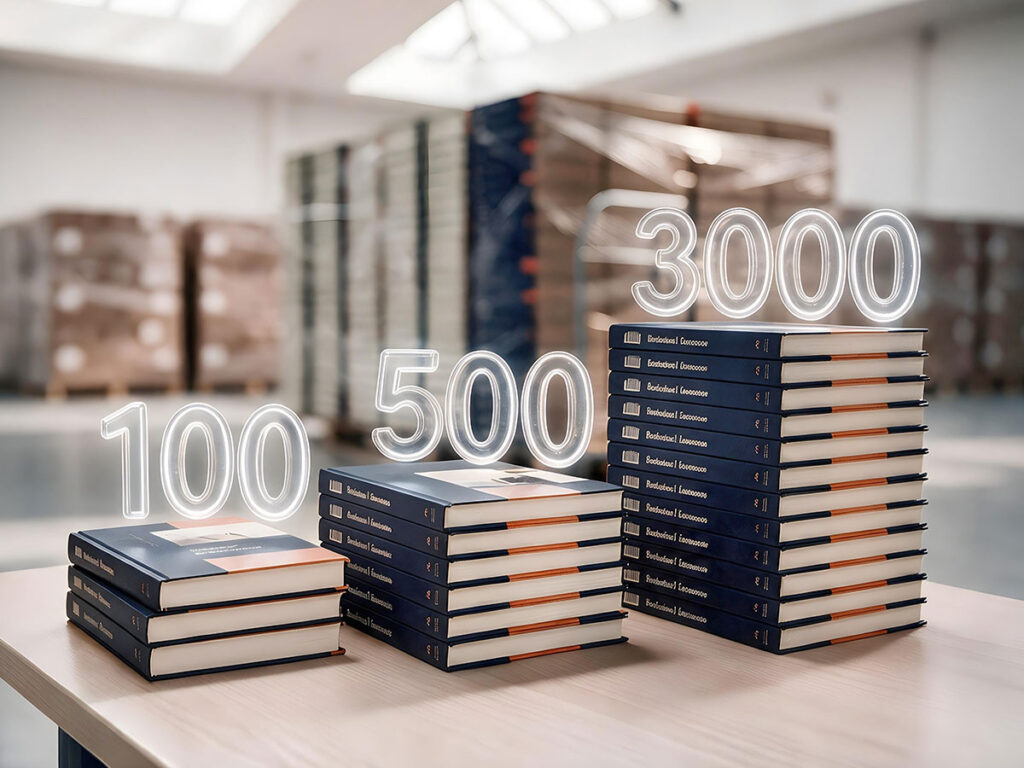
The lowest price per copy does not always mean the cheapest project. You can order 3,000 copies, be delighted with the unit price and, a few months later, find yourself looking at pallets of unsold books and paying to store them. Or you can print 100 copies, sell them within a week and quickly order a reprint.
The number of copies is planned one way by a publisher with established distribution, another way by an author with their own community, and yet another by a self-publisher preparing a first title. They differ in budget, pace of sales, access to storage and the level of risk they can accept. A larger order usually lowers the unit cost, but it also raises the total production cost and increases the number of books that later have to be sold, stored and shipped. A book print run should follow from your sales plan, not simply from the wish to get the lowest price per copy.
Why does a larger print run cost less per copy?
Some of the costs of preparing production arise regardless of whether you print 100, 500 or several thousand copies. With a larger order, they are spread across more books, which is why the price of a single copy can drop noticeably.
That does not mean, however, that the largest print run will automatically be the most cost-effective.
Take an example A5 book: 300 black-and-white pages on 70 g/m² cream volume paper, a cover made of 250 g/m² one-side coated paperboard, perfect-bound softcover. If we take the cost of one copy at 100 copies as the reference point, it looks like this:
- 100 copies: 100%,
- 500 copies: approx. 50%,
- 3,000 copies: approx. 35%.
The unit cost really does fall. The order as a whole, however, looks different:
- 100 copies: reference point,
- 500 copies: a budget roughly 2.5 times larger,
- 3,000 copies: a budget about 10 times larger.
With a large print run, you save on each copy, but you commit a much bigger budget at the outset. The money only comes back once the books are sold. You can calculate the real cost of a specific specification—size, page count, paper, binding and print run—yourself in the Books Factory calculator. Once you create an account, the calculator shows discounted prices for registered users, and for larger or regular orders it is worth discussing terms with your account manager.
The cost of publishing a book therefore has to be calculated more broadly: production is only one part of it. Add transport, storage, packing, order handling, possible returns and the time during which capital remains tied up in an unsold print run.
100 copies: a good first print run?
A short print run gives you, above all, flexibility. You can print a hundred copies, put them on sale, watch the response and only then plan the next batch. This kind of first print run makes sense for a debut book, a niche topic, sales run mainly through your own website, or when demand is still hard to predict.
The author does not have to invest a large sum straight away or find space for dozens of boxes. A hundred copies is also enough for the first sales, review copies, mailings to partners, author talks and promotional events.
Selling the first 100 copies tells you more than a forecast
The first print run can act as a market test. Instead of basing the next decision on predictions, you already have hard data.
Once the first batch has sold, you know:
- how many copies sold in the first week and month,
- which sales channels work best,
- how many books your newsletter or social media audience buys,
- how many copies sell at events and meetings,
- whether interest holds up after the launch.
Order a reprint in advance—so that the new batch arrives before the previous one runs out.
500 copies: more room to sell
A print run of 500 copies gives you enough stock to sell through several channels without frequent reprints.
This number of copies may be justified once the author already has early data on demand. What counts are pre-orders, sales of previous titles, orders from bookshops, an active mailing list, results of earlier campaigns and interest from partners. For example: 120 books were sold in pre-orders, a trade partner orders 80, 30 copies are going to reviewers, and a previous title sold around 150–200 copies in its first months. In that situation, 500 copies are backed by data rather than an optimistic assumption.
A mid-sized print run also lets you benefit from a lower unit price without committing a budget comparable to a large production run.
When might 500 copies be too big an order?
An author’s follower count does not tell you directly how many books will be bought. Video reach, likes or comments under a launch announcement are not the same as sales either. Only purchases show what share of interest turns into orders.
An author with 20,000 followers may sell several hundred books in a few days, but may also need many months to reach that result. It all depends on the relationship with the audience, the book’s price, the topic and how it is promoted. If social media reach is the only argument for 500 copies and there are no pre-orders or previous results, it is safer to start with a smaller batch.
3,000 copies: when is a large print run justified and cost-effective?
A large print run becomes attractive when a lower unit cost goes hand in hand with predictable sales. Three thousand copies is the scale at which mid-sized and larger publishers typically order. Such a print run is justified with wide distribution, confirmed trade orders, strong pre-sales, or a new book by an author whose previous titles achieved similar results.
At this scale, you need to look at the project as a whole. The printing itself may be competitively priced, but 3,000 books have to be stored somewhere, received into a warehouse, packed and delivered to customers.
The nature of the publication also matters. A novel can stay relevant for years. A textbook, a technology guide or a law book can date much faster. Ordering several years’ worth of stock for content that is likely to go out of date increases the risk that some copies will never reach readers.
Storage also affects cost-effectiveness
Storage costs should go into the calculation just like printing. With a large print run, the following also matter:
- delivery from the printer,
- receiving and unloading pallets,
- warehouse space,
- order picking,
- packaging materials,
- shipping.
A cost-effective print run is therefore not the one with the lowest per-copy price on the invoice. The print run that pays off is one you can sell within a reasonable time and without excessive costs along the way.
How do you calculate a book print run?
It is best to start with expected sales over a specific period. Three months, six months or a year are a much better reference point than asking how many copies might “someday” find buyers.
Your calculation can include:
- the number of pre-orders,
- sales of previous publications,
- orders from bookshops and distributors,
- the size of your own customer base,
- the number of promotional copies,
- legal deposit copies, if your country requires them (in the UK, for example, one copy for the British Library and up to five more on request),
- planned events and meetings,
- seasonality,
- the time needed to produce the next print run.
Example: 200 books already have specific buyers, we plan to sell another 150 copies in the first few months, 30 are set aside for promotion, and we want to keep 50 as a safety stock. That adds up to 430 copies. Rounding up to 500 leaves an extra margin without creating a large surplus.
How do you calculate a print run when you have no previous results? In that case, pre-orders and a short first print run should carry more weight. We explain when a short print run pays off in the article “Short-run book printing: when does it pay off?”. Data from the first batch will help you plan the next order more accurately.
Pre-orders help separate interest from sales
Pre-orders show how many people actually want to buy the book before its release. That is much stronger information than reactions to posts or declarations in comments.
Just don’t assume that the pre-order result will repeat every month. A launch usually concentrates a large share of interest in a short period. Afterwards, sales may slow down and settle at a much lower level.
The type of publication changes how you plan a print run
A general fiction novel, an academic publication and a corporate album may share a similar format, but their sales will look completely different.
A specialist monograph may have a small, well-defined readership and sell over several years. A popular book may achieve most of its sales in the first few months. Conference proceedings or anniversary publications often have a number of recipients known in advance.
When planning a print run, you therefore need to consider:
- the book’s subject,
- the size of the target audience,
- the distribution method,
- the length of the sales period,
- how quickly the content may go out of date,
- the retail price,
- the promotional capabilities of the author or publisher.
A single print run or regular reprints?
Digital printing makes it possible to produce books in smaller batches, so the entire expected sales volume does not have to be produced with the first order.
Instead of:
3,000 copies → storage → gradual sales
some projects can adopt this model:
500 copies → sales → results analysis → reprint.
The first batch will have a higher unit price, but it reduces the risk of overproduction. With predictable demand and efficient distribution, a single print run can still be the better option—what decides is how predictable sales are, not scale alone. Subsequent print runs can be matched to the actual pace of orders.
A reprint has one more advantage. Between batches, you can make minor corrections, fix a typo you have spotted, update information or change an element that turned out to be problematic after the launch.
100, 500 or 3,000 copies?
100 copies let you enter the market with little risk and test demand. This suits first publications, niche books and projects for which you do not yet have reliable data.
500 copies give you more room at launch and a lower unit cost. This print run is worth considering when some sales are already confirmed or previous results allow you to estimate demand.
3,000 copies require efficient distribution, a larger budget, storage space and sales that justify that scale. A lower unit price only pays off when the books actually leave the warehouse.
So when choosing a book print run, you look at more than the cost of one copy. You check how many books you can sell, how quickly you can reprint, how much storage costs and how much money you want to commit at the start. You can compare each of these options on your own specification in the Books Factory calculator—before you decide on the print run.
FAQ: book print runs
How many books should you print to start with?
For a debut or a niche publication with no sales data, ashort print run, e.g. 100–300 copies, with the option of reprinting later, may be the more sensible choice.
Does a larger book print run always pay off more?
A larger book print run usually lowers the cost per copy, but it increases total spending, the number of books to store and the risk of an unsold surplus. A cost-effective print run should take into account not only the price of one copy, but also the pace of sales.
How do you calculate a print run before publication?
When calculating, take into account pre-orders, orders from bookshops and partners, results of previous publications, the number of promotional copies and expected sales in the first few months.
Is it better to print 3,000 books at once or to reprint?
It depends on how predictable sales are. With confirmed orders, wide distribution and an author with a proven track record, one large print run usually means a lower unit cost and simpler logistics. With less predictable demand, smaller batches and reprints matched to the pace of sales are often the safer option.
What has the biggest impact on the cost of publishing a book at different print runs?
Printing costs—and therefore a significant part of the cost of publishing a book—depend on factors such as the number of copies, size, page count, paper type, black-and-white or colour printing, binding and finishes. The full cost of publishing also includes editing, proofreading, typesetting and cover design. When comparing print runs, you also need to add transport, storage and handling of the finished copies.