


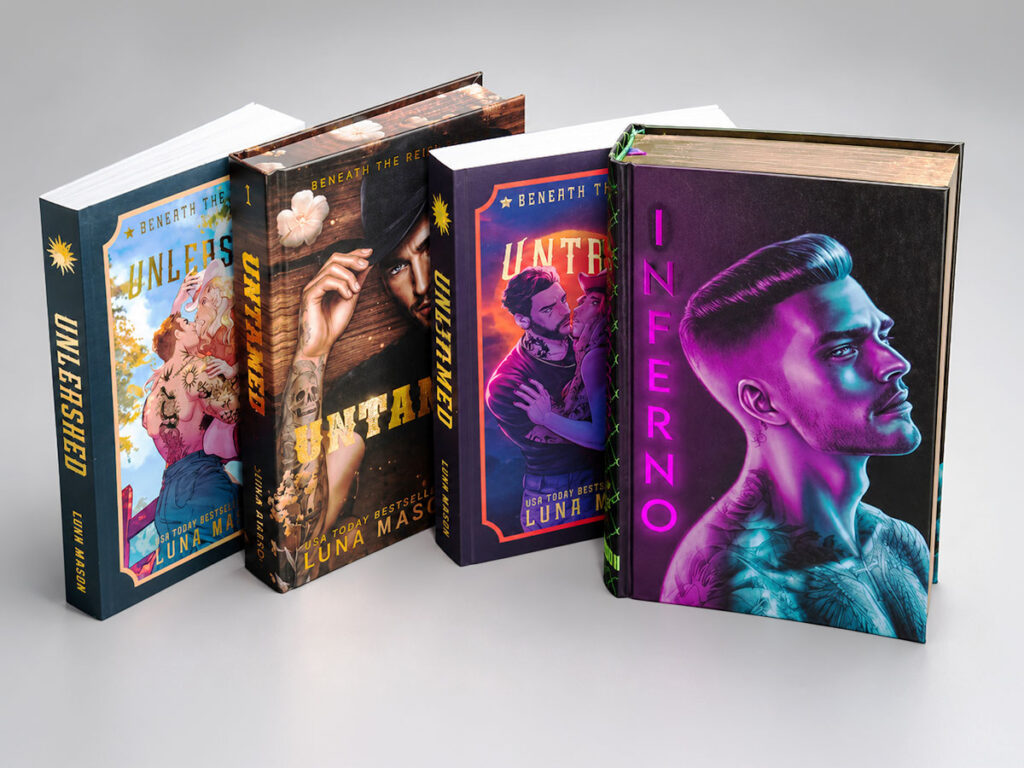
Luna Mason, an independent romance author based in the UK, prints her books with Books Factory and sells them through bookstores in the UK, the US, Canada, Australia and New Zealand. At the end of September 2026, her novel “Unleashed” from the “Beneath the Reign” series reached No. 148 on the USA Today bestseller list. Her first order with Books Factory was just under 1,000 copies, shipped to 2 addresses. Her latest was around 2,000 copies, shipped to 37 addresses.
Behind that growth are production decisions any author or publisher can replicate: a safe start with a proof copy, printing a series in shorter runs with regular reprints, premium finishes for collector’s editions, and shipping a single order to many bookstores. We walk through each of them with Cyril Goy, who looks after Luna at Books Factory.
Key takeaways
- Books Factory prints Luna Mason’s series, reprints and collector’s editions, and splits a single order across many shipping addresses—37 in her latest one.
- Books Factory produced collector’s editions with edge printing and metallic foils for her in runs of 75, 300 and 380 copies.
- Books printed in Poland go straight to bookstores in other countries, with Books Factory handling customs formalities.
- Instead of one large run, the author prints several titles in her series in shorter runs and reprints them regularly.
- Working with Books Factory can start with a free, no-obligation proof copy and a set of Sample Books.
- The author has a dedicated account manager at Books Factory and stays in touch mainly via Instagram.
Why does an indie author need a printer that thinks like a business?
Luna Mason doesn’t work with a publisher. She decides what to publish and sells it herself: through bookstores, online and on Instagram, where around 68,000 people follow her. Her company is based in the UK, and she splits her time between the UK and the US.
From the start, Cyril Goy saw her first and foremost as a businesswoman:
Many authors don’t focus on the business side of publishing—they act more like artists. She really knows what she’s doing, and she does it really well. – Cyril Goy
The difference shows in her pace. Many authors keep putting decisions off: one more fix in chapter three, one more month to find the budget, sell first and reprint later. The project then drags on for months. Luna has many titles to publish, so she works to a rhythm Cyril sums up in four words: produce, sell, produce, sell. That rhythm needs a printer that responds quickly and looks at a print run in terms of sales, not just production.
Of course you’re an artist and a writer. But at some point, if you want to make a living from it, you have to start thinking about the business. – Cyril Goy
Before she came to Books Factory, the author had printed with several different printers. She wasn’t openly unhappy with them, but problems did come up, and her previous setup was simply the least bad option available. The hardest part was finding a printer that could handle advanced finishes on small runs, such as gilded page edges or several metallic foils on a single cover.
How do you start safely with a new printer?
Switching printers is a risk, especially when your readers judge you by the quality of the book. Luna Mason kept that risk low in three steps.
She checked the quality on her own book. Books Factory prepared a free, no-obligation proof copy for her. She could assess the printing, binding and finishes before committing to a print run. A proof copy shows what a PDF can’t: how the paper renders colour, how the book opens and how the finish catches the light.
She saw what else was possible. Along with the proof copy, she received Sample Books—a set of reference books showing different bindings, papers and finishes. Some of her later ideas for collector’s editions came straight from them.
She grew step by step. After the proof copy came a small order, then a bigger one. Her first full order was just under 1,000 copies.
When you don’t know the printer, you start with a small order. When you see that the printer is there for you and always looks for a good solution, you become more confident. – Cyril Goy
Contact turned out to be just as important. The author had spoken to Books Factory at book fairs and by email, but the relationship was built on Instagram. There she can message her account manager at any time, even with a small question that would otherwise sit in an inbox for days. For an author running a business, what counts is having a real person on the other side who knows her project.
If I need to check something, I won’t reply within a second—but within the hour, yes. For an author who runs a business, getting information on time is what matters most. – Cyril Goy
How many copies should you print?
Many authors and publishers print a single title in one large run, say 2,000 copies, because that’s where the unit price looks best. Cyril suggests looking past the unit price and asking when the run will actually start paying for itself:
When will you sell the last of those 2,000 copies? In a year? How much does storage cost you in the meantime? When do you start making money? In a year, a year and a half—maybe never. – Cyril Goy
The same money can be spread differently. Instead of one title in a large run, you can print several titles at 200–500 copies each. Each copy costs a little more, but the overall decision looks very different:
| One title, large run | Several titles, shorter runs | |
| Unit price | lower | slightly higher |
| Time to sell the run (from Cyril’s experience) | a year or more | a few months |
| Storage | a cost throughout the sales period | minimal |
| What readers can buy | one title | several titles that drive each other’s sales |
| Return on investment | delayed | faster |
More titles also mean more chances of a follow-up sale: a reader who enjoys the first book will reach for the next. And if someone asks for a title that has run out, that sale is simply lost.
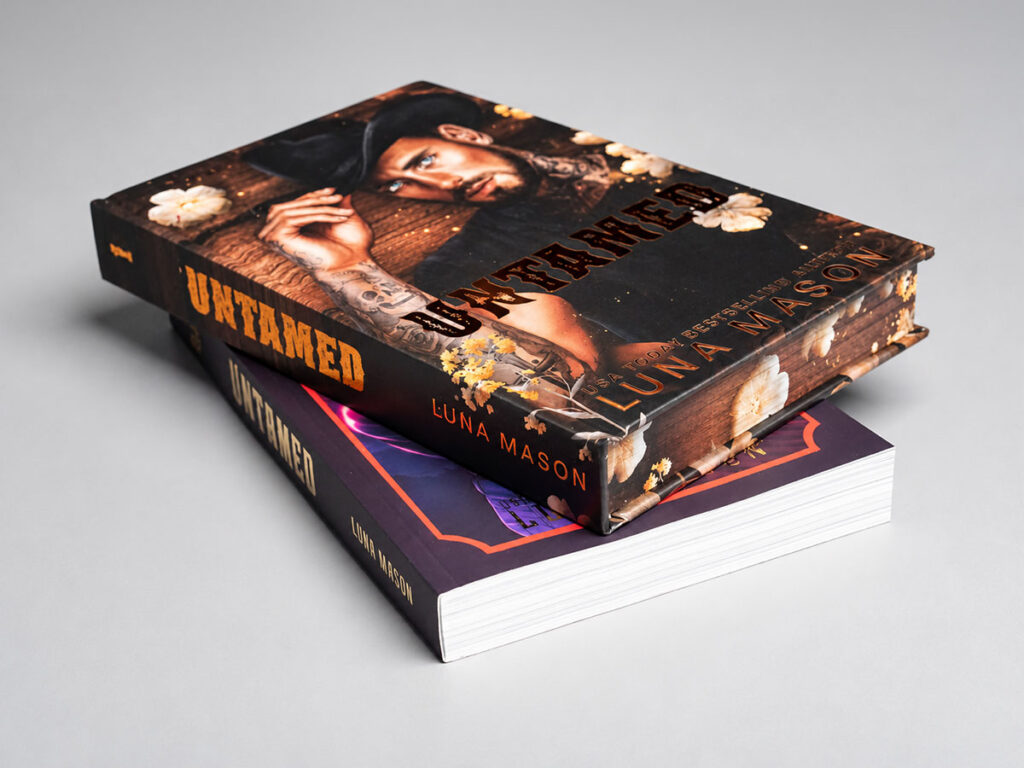
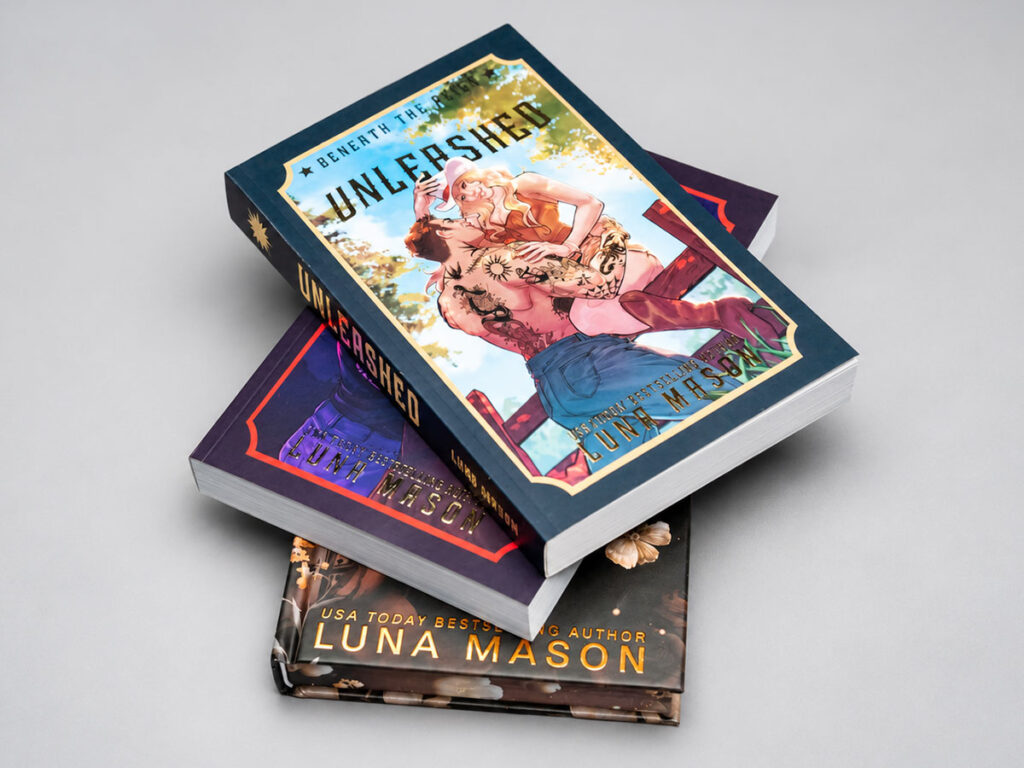
This is how Luna Mason works. She started by printing “Untamed”. Her next order added the new instalment, “Unleashed”, together with a reprint of “Untamed”. After that she was printing three titles at once, including the third book, “Unchained”. She prints the most copies of the newest title, because that’s where demand is highest, but it’s the new title that drives interest in the earlier books.
It’s like “Game of Thrones”. If you only watch the last episode of season two, maybe you’ll go back to season one. The bookstore sells book one, then book two, and then it needs book one again. It becomes a cycle. – Cyril Goy
Then there are the editions. The same content can take several forms: the standard edition, a reprint, an event edition, a signing edition and an omnibus. That way, three titles can become eight to ten products for different groups of readers.
Which editions are worth investing in premium finishes?
Cyril’s rule is simple: premium finishes make the most sense where readers buy a book not only to read it, but to own it. A collector’s edition sells fewer copies than the standard edition, which is exactly why it pays to shift the budget towards the finish there.
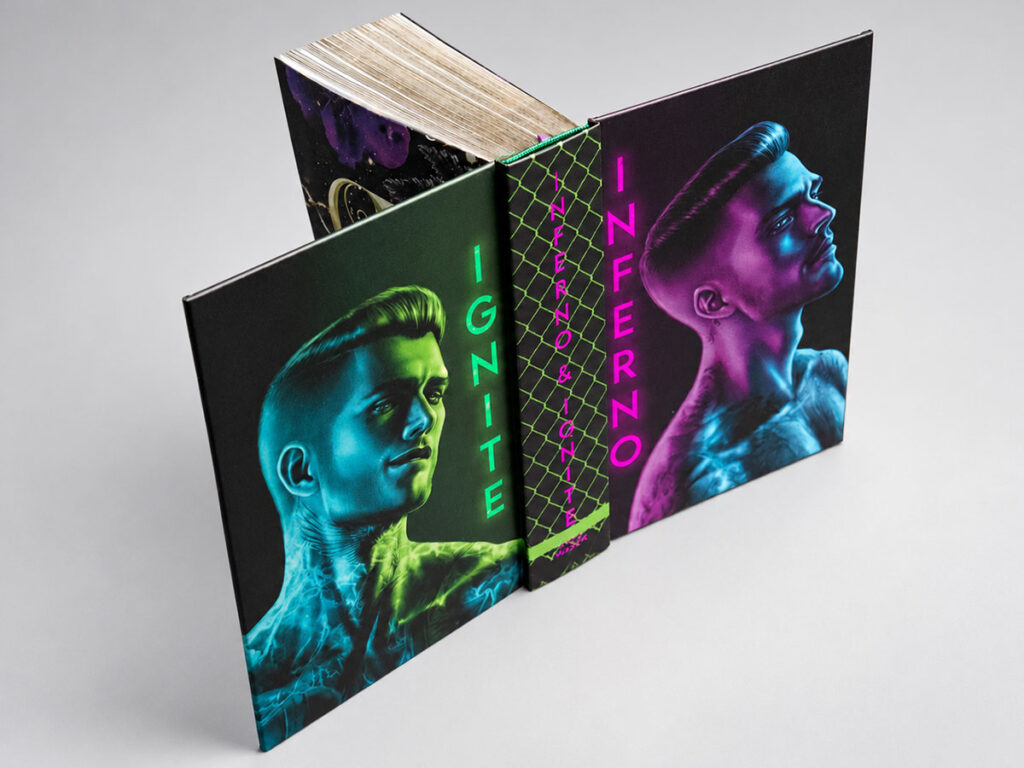
The omnibus. One of the author’s first projects with Books Factory was “Inferno & Ignite Omnibus”, several titles collected in a single volume. She had planned something more standard: CMYK edge printing, perhaps a hardcover. Once she saw which finishes could be combined, she went for gilded page edges, two metallic foils on the cover and endpapers printed on both sides. The book block runs to 924 pages and was printed in economical mono, so the collector’s effect comes from the binding, not the interior. Print run: 380 copies.
The event edition. “Chaos – Vegas Edition” was created for an author event in Las Vegas: a new cover with a casino theme, edge printing and red metallic foil. Print run: 300 copies. Time was short, but the file was already polished, so the project could go straight into production.
I told production: this is a very good author, the file is ready, we can go straight ahead. And we made it. She was very happy, and so was I. – Cyril Goy
The signing edition. “Inferno Signing Edition” is 75 hardcover copies with edge printing, gold metallic foil on the cover and a dust jacket with silver metallic foil.
All three editions were produced in a single order. They show that a collector’s edition with edge printing and metallic foils doesn’t need a run in the thousands—a few dozen copies are enough.
How do you sell books through bookstores in other countries?
An author who builds a readership on social media soon runs into the same problem: demand comes from several countries, and the books have to physically reach many bookstores at once. This applies to a UK author selling in the US just as much as to an author in Poland who wants to be stocked in the UK or Germany. Bookstores don’t order a thousand copies. They order a dozen or a few dozen.
Luna Mason described this challenge herself when she thanked bookstores after “Unleashed” made the USA Today list:
Firstly to the amazing bookstores who have worked with me to keep my cowboys stocked, which with me being in the UK has been a logistical challenge BUT WE DID IT. – Luna Mason, Instagram
Books Factory solves this with multi-address shipping. A single order is split and sent to many addresses in different countries, directly to bookstores. The author’s latest order, around 2,000 copies, went to 37 addresses. Her account manager coordinates how the run is split and shipped, and Books Factory takes care of customs formalities. The author doesn’t need her own warehouse or a middleman, and customs procedures stop being her problem.
It’s a complete game changer. We can ship the books to the bookstores directly from here. – Cyril Goy
The second element is a fast answer. The author often travels to the US for signings, and that’s where opportunities come up—an invitation to a book fair in New York in a few weeks’ time, for example. She then needs someone who can tell her the same day, or the next morning at the latest, whether printing books for that event is realistic. When you work across time zones, a dedicated account manager turns that into a single message.
What should you expect from a printer as a partner?
Cyril puts it plainly: he isn’t just a sales rep at a printing company, he’s a partner. In practice, that means three things.
A quote that looks for savings. When a client asks for a price, Cyril prepares not only the standard quote but also a version with suggestions. It shows how changing the format by a few millimetres, choosing an equivalent paper or adjusting the run would affect the cost of the whole project. That’s knowledge from years in production that authors rarely have, and it can make a real difference to the numbers.
Responsibility when something goes wrong. Damage in transit or a scuffed cover can happen. What matters is who takes ownership when it does.
I won’t leave my clients on the side of the road. I won’t shift the blame onto the transport company. We’re on the same team. – Cyril Goy
Thinking in terms of a whole catalogue. The goal isn’t a one-off print job, but working together on new titles, reprints and editions.
The goal is not to print with someone once. We want to print their whole catalogue and build a long-term relationship. – Cyril Goy
That’s why what gives him the most satisfaction is seeing how Luna Mason has grown with Books Factory. He compares it to being a coach: it’s not the coach who wins the match, but his advice shows in the players’ results.
His advice for authors and publishers who are still planning a project is simple: talk before you order anything. About the goal, the target audience, the content and what the book should look like.
We’re not publishers, we’re printers. But we see what we print, and we know what works and what doesn’t. – Cyril Goy
Planning a series or a collector’s edition? Order your free Sample Books and talk to an account manager about planning your print runs, finishes and shipping.
FAQ
Can an independent author print books in Europe and sell them through bookstores in other countries?
Yes. Books Factory prints books in Poland and splits a single order across many shipping addresses in different countries, directly to bookstores, including customs formalities. This is how Luna Mason supplies bookstores in the US and elsewhere; her latest order went to 37 addresses.
Does a collector’s edition with edge printing require a large print run?
No. In Luna Mason’s case, the smallest edition with edge printing and metallic foils was 75 copies. The best way to check which combinations of finishes work for a specific run is to discuss it with an account manager.
Is it better to print one large run or several smaller ones?
It depends on how quickly you sell. A large run gives you a lower unit price, but it ties up money and generates storage costs. Several titles in shorter runs with regular reprints let you recover your investment faster and give readers more choice.
How can I check print quality before ordering a run?
Books Factory prepares a free, no-obligation proof copy of your book. You can also order free Sample Books—a set of reference books showing different bindings, papers and finishes.
Sources:
- Interview with Cyril Goy, the author’s account manager at Books Factory, 1 October 2026.
- Order data from the Books Factory system: first order of 5 September 2025 (edition specifications, print runs) and the latest order (number of copies and addresses).
- Luna Mason’s Instagram post (@authorlunamason), September 2026: “Unleashed” on the USA Today bestseller list, quote on logistics.