



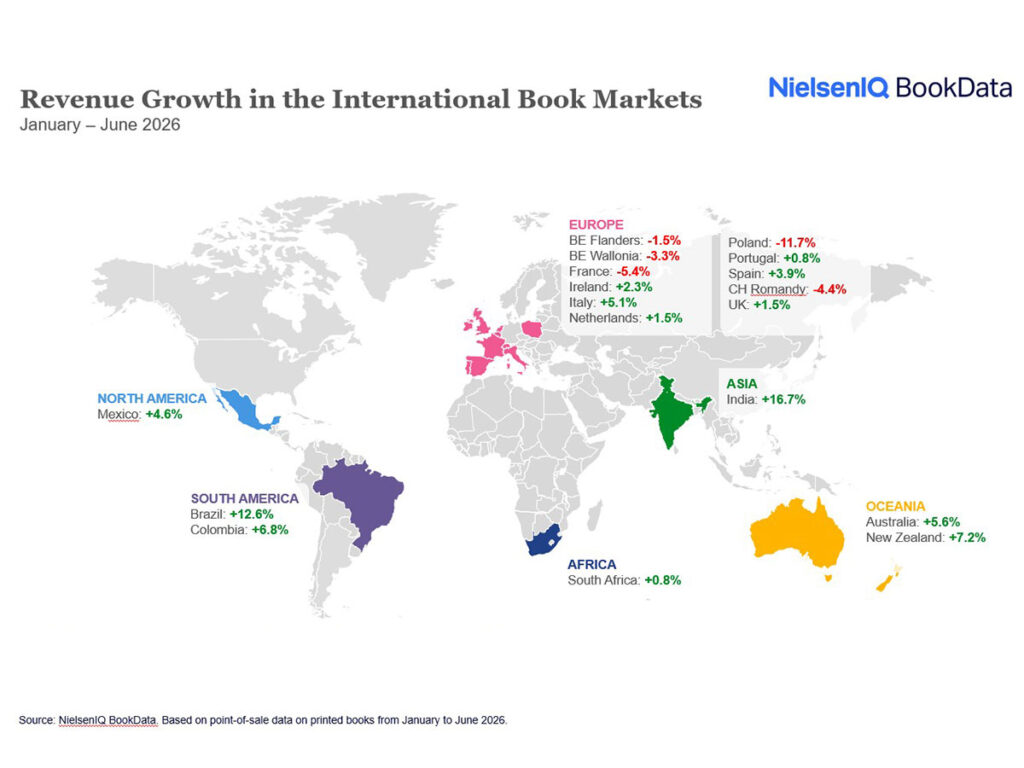
UK book buyers spent more on printed books in the first half of 2026 (+1.5%) but bought fewer of them (−1.1%, 82 million copies). It is one of the clearest patterns in the latest NielsenIQ BookData and GfK Entertainment report, presented ahead of the Frankfurt Book Fair: most markets are growing, adult fiction remains the main engine, and in the UK the growth comes from prices rather than volume.
Most markets are in positive territory
Revenue from printed book sales rose in 11 of the 19 territories. India (+16.7%) and Brazil (+12.6%) grew fastest, but major European markets also posted gains: Italy (+5.1%), Spain (+3.9%) and the UK (+1.5%). Poland (−11.7%) and France (−5.4%) saw clear declines.
Unit sales grew in nine territories. France remains the largest market in the report with 124 million books sold, ahead of the UK with 82 million. Average prices rose in 11 territories, usually more slowly than the IMF’s projected global inflation for 2026 (4.7%).
Europe: prices, volumes and a few exceptions
In the UK, revenue grew while unit sales fell, which by our calculation means the average price per copy rose by around 2.6%. Children’s books declined in the UK despite the boost the report attributes to events such as World Book Day. Ireland, by contrast, was among the markets that sold more books than a year earlier.
Elsewhere in Europe the picture is mixed. Italy grew by 5.1%, helped early in the year by a library purchase bonus, and Spain (+3.9%) also sold more copies. The Netherlands and Flanders sold fewer books, although the Netherlands is one of only three markets where non-fiction grew. Children’s books declined in Spain, the Netherlands, Belgium and Portugal as well.
What sells: adult fiction, series and graphic novels
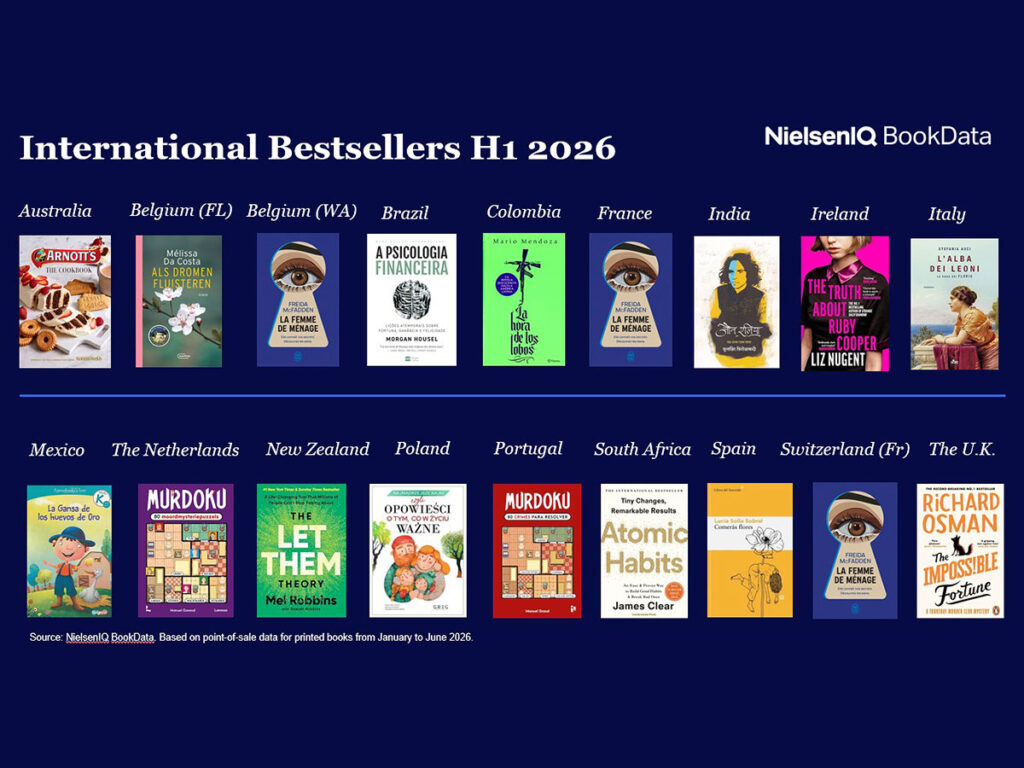
Adult fiction now accounts on average for more than a third of all printed books sold. Its revenue is growing in three quarters of the territories, often by double digits. Crime and thrillers lead the way: Freida McFadden’s “The Housemaid” series made the top 20 bestsellers of the half-year in 13 territories.
The second pillar is fantasy, especially romantasy. Series by Rebecca Yarros and Sarah J. Maas are among the strongest growth drivers, and the report links their success to BookTok, which keeps bringing genre fiction to younger and increasingly international readers. The fastest-growing segment, however, is graphic novels: in many countries their revenue rose by more than 30%.
What is losing ground: non-fiction and self-help
Non-fiction grew in value in only four countries, and in many markets readers are shifting towards fiction. In Brazil, non-fiction accounted for more than half of all books sold five years ago; today it is 40%.
Personal development is weakening most clearly. James Clear’s “Atomic Habits” and Mel and Sawyer Robbins’ “The Let Them Theory” remain international bestsellers, yet the category is declining in every territory surveyed except New Zealand.
What this means for publishers
This is our interpretation of the data, not a conclusion of the report.
Plan print runs by category, not by the market average. Where a category is growing, as in genre fiction, romantasy and graphic novels, a larger first print run is backed by the data. Where it is weakening, as in self-help and personal development, start more cautiously and plan reprints from the outset.
Think in series, not single titles. The half-year bestseller lists are largely made up of series and established brands, from McFadden’s thrillers to children’s books. If you publish a series, fix the format, paper and binding so that later volumes and reprints form a consistent set on the shelf.
Test special editions on your own data. The report does not measure them, but in the orders we produce, book edge printing increasingly appears on romantasy and on titles built around the BookTok community. Whether such an edition pays off for a specific title is best tested through pre-orders or a short special run.
And if you are now wondering how many copies to order next year, that is a good question to bring to us: we will help you match the print run and specification to your category, not to the market average.
Sources:
- NielsenIQ BookData and GfK Entertainment, “International Book Market 2026”, press release, 5 October 2026
- Publishers Weekly, “Frankfurt Book Fair 2026: Majority of Book Markets are Growing in 2026” (detailed category and market data)
- Publishing Perspectives, “Library Purchases Boost the Italian Book Market to Start 2026”
- Books Factory’s own calculations based on the above data (average price per copy)