


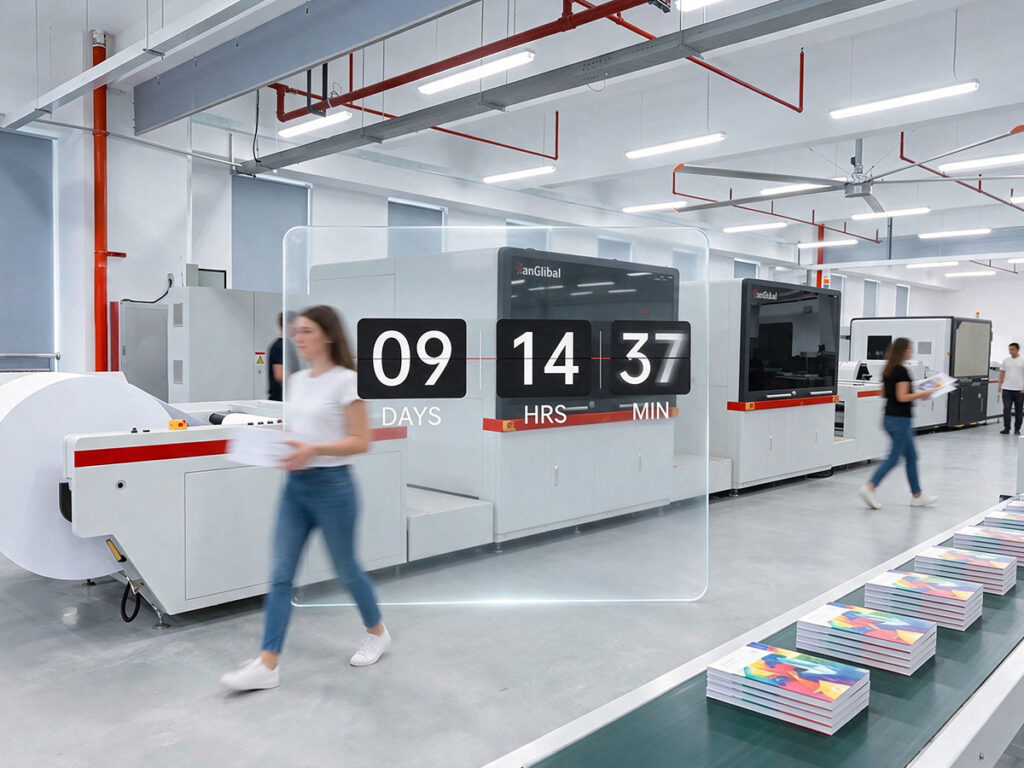
A finished layout and a fixed launch date do not mean the book can reach readers straight away. Between handing over the files and collecting the print run there are several stages: technical checks, printing, binding and preparation for shipping. How long does book printing take, and what can push the date back? We explain how to plan production without rushed last-minute decisions.
How long does book printing take at a printing house?
There is no single lead time for every publication. At Books Factory, the indicative production time for softcover books is 7–13 working days, and for hardcover books 9–19 working days. These are not guaranteed dates for every order: the exact date depends on the book’s specification and the production schedule. You will always find the current lead times for your chosen binding below the price calculator on the product page.
Lead times are counted in working days, i.e. excluding weekends and public holidays. File issues can, however, put production on hold. If the print run is to be delivered to a publisher, warehouse or distributor, you also need to add delivery time to the planned collection date.
Which stages of book production should you plan for?
File checks and prepress
All files sent to Books Factory go through a two-step check. First, your sales representative checks that the page count matches the order and that bleeds are present. Then our DTP team carries out a detailed manual check covering, among other things, the CMYK colour space, resolution (DPI), page layout, font embedding, 100% K black and whether files are complete for every component of the book.
If any errors are found, you and your account manager are told what needs to be corrected or resent. The most common problems are a book block page count that does not match the order and missing bleeds. Having to prepare corrected files can extend the lead time.
Printing the book block and cover
Once the files are approved, the book block (the inside pages of the book) and the cover are printed. How long this takes depends on the print run, page count, technology and print coverage. A short text-only volume requires different work than an extensive illustrated album.
Binding, finishing and preparation for shipping
Sheets or signatures are gathered into a book block, which is then bound. Depending on the project, this includes gluing or sewing, joining the block to the cover, trimming and any refinements. Finished copies are inspected and packed. That is why the printing itself is only one part of the whole production process.
What affects book production time?
Print run and page count
A larger print run means more machine time and more binding operations. The page count, in turn, affects paper consumption and the number of sheets or signatures. That does not mean, however, that doubling the print run automatically doubles the production time.
Paper type and format
The paper must suit both the printing technology and the construction of the book. Materials that need extra arrangements can lengthen preparation. A non-standard format also matters, as it affects how pages are imposed on the sheet and how they are processed further.
Binding type
Production time depends both on the type of binding and on how the book block is bound—glued or sewn. A hardcover also requires a rigid board cover, which is covered with printed paper and only then joined to the block. That is why it is worth checking the lead time in the price calculator for your specific binding.
Refinements and additional elements
Cover lamination, spot UV varnish, metallic foil or book edge printing require additional operations, and some of them also need separate design files. They do not always extend production significantly, but it is worth including them in your schedule as early as the specification stage.
Printing house workload
Similar books can have different lead times because of the production queue and seasonality, especially in the pre-Christmas period. Always confirm the date for the specific order instead of assuming it will be the same as for the previous print run.
Digital or offset printing: which is faster?
Digital printing makes it possible to start printing without preparing offset plates. This shortens the prepress stage and makes print-on-demand book production easier, including for short runs and reprints. Books Factory specialises in digital printing—our range includes Standard printing (electrophotographic) as well as Economical mono and colour printing (inkjet).
Offset requires printing plates and machine set-up, so for smaller print runs getting production started tends to take longer. For very large print runs, the head start of digital printing matters less, and the lead time depends mainly on the binding and on available production capacity.
This does not mean that every digitally printed book will be ready sooner than every offset one. The final lead time also depends on finishing and the bindery’s work. Even if the printing itself runs smoothly, the book still has to go through the bindery.
How do files and approvals affect the lead time?
The most costly changes for the schedule are often those made only after the design has been submitted. Missing bleeds, the wrong format, an incorrectly prepared spine or non-embedded fonts mean the files have to be prepared and checked again. If the page count changes after corrections, the cover design may need updating too. The Books Factory file preparation guidelines will help you avoid this.
If you need a proof copy or an additional approval round, allow time for review and any changes before the full print run.
It is also worth agreeing who on the publisher’s side gives final approval for the project. If every correction has to be discussed with several people, even a minor change can hold up further work. A clear division of responsibilities makes decisions easier.
How to plan book printing ahead of a launch?
Plan your schedule backwards: start from the day the copies must reach the distributor, a book fair or an author event. After production, they still have to be transported and distributed to recipients.
- Finalise the specification before the layout is closed. Define the format, paper, print run, binding and refinements so that the design suits the technology.
- Check the lead time for your chosen option. Provide all the parameters and ask for the date to be confirmed.
- Allow time for the DTP check. Check your files before sending them and bear in mind that corrections may be needed.
- Factor in approvals and transport. Plan for a proof copy, editorial decisions and delivery, if required.
- Leave a buffer before the launch. Don’t schedule collection for the day of the event; a time buffer lets you react to corrections or delivery delays.
A plan like this reduces delays caused on the author’s and publisher’s side. It also helps separate tasks that must be completed before printing starts from those that can run in parallel, such as preparing promotion or materials for distributors.
FAQ: common questions about book printing lead times
Will a short run always be printed faster?
Not always. Fewer copies can shorten the printing itself, but the book still needs file checks, binding and finishing. The chosen technology and the order queue also matter a great deal.
Does a reprint of the same book take less time than the first edition?
Not necessarily. Files that have already been prepared and approved can make reordering easier, but they do not eliminate all production stages. The lead time has to be set for the new print run, especially if the book’s specification has changed.
Does a proof copy extend the lead time?
If it has to be produced and approved before the full print run, it adds a stage to the schedule. At Books Factory, the proof copy is free of charge and comes with no obligation, so it is worth planning time for it—especially if you want to assess the paper, colours or construction of the book before the launch.
Does the production lead time include delivery?
You should not assume so. The production completion date and the delivery date are two different things. It is worth agreeing on the transport method and delivery address in advance.
Publish your book without a last-minute rush
A good schedule starts with a specific specification and correct files, not just with a launch date. If you are planning to print with Books Factory, explore our softcover and hardcover options and discuss the lead time with your account manager. This will make it easier to fit production into your publishing calendar.
To avoid corrections to your files, also read PDF/X-1a or PDF/X-4: how to save your book file for printing. Wondering how large your first print run should be? Find out when short-run book printing pays off.
Sources: