


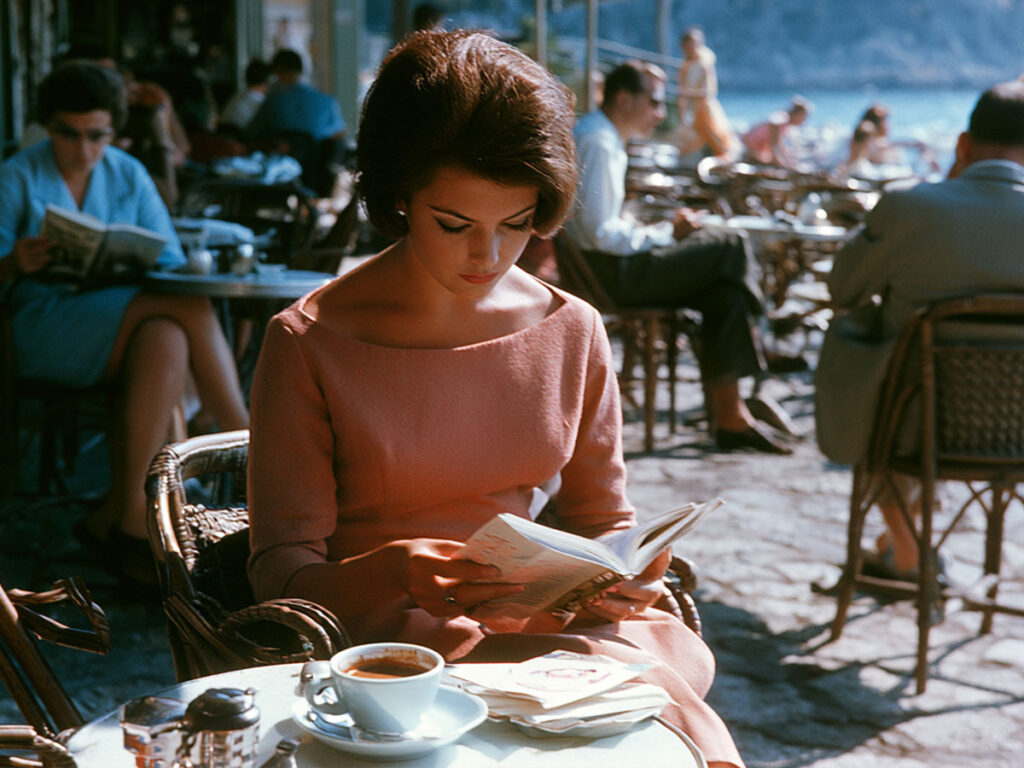
Was reading on the beach, on the train or on a sun lounger beneath a parasol ever something natural and timeless? We like to imagine that people have been relaxing with a book in hand for generations, yet that picture is far more recent than it seems. For most of history, the vast majority had no holiday at all. Travelling for pleasure was the privilege of the few, and a book – for a great many people – was simply too expensive to take “on holiday”.
Holiday reading as we know it is a relatively recent arrival. It came about thanks to three revolutions that happened at roughly the same time: the introduction of paid holidays, the growth of the railways and tourism, and the spread of cheap pocket-sized books. Let’s trace how these elements combined to create a custom we now take entirely for granted.
Before holidays existed, there was no holiday reading
To read for pleasure in your free time, you first need to have that free time. And for centuries, free time was in short supply. The lives of most people were governed by the rhythm of work: in the fields, in the workshop, and later in the factory. The institution of the “holiday”, in today’s sense, simply did not exist.
People did, of course, travel in earlier times, but rarely in order to rest:
- trading journeys – undertaken out of necessity, not for relaxation,
- pilgrimages – religiously motivated, often arduous and long,
- the Grand Tour – months-long journeys around Europe, available to the aristocracy and to wealthy young people in the eighteenth century, regarded as part of one’s education.
The common denominator is clear: rest combined with travel remained the luxury of a privileged handful. It is hard to speak of a “culture of holiday reading” when the holidays themselves – mass holidays, available to ordinary people – simply did not exist.
A culture of holiday reading could only emerge once free time stopped being the privilege of the few.
1936 – when millions of people got a holiday for the first time
The turning point came in the twentieth century, and it had a precise date. In France in 1936, the Popular Front government introduced two statutory weeks of paid leave for workers. For the first time on a mass scale, ordinary people received something they had previously known only from stories about the upper classes: the right to rest while still being paid.
The effect was immediate and spectacular. That very same year, more than 600,000 workers, together with their families, set off on holiday away from home. Railway stations filled with people who had never before travelled simply for the pleasure of being somewhere else.
This moment was captured by the camera of Henri Cartier-Bresson. His photographs show the first generation of workers relaxing by rivers, on beaches and on day trips: people who were only just learning what free time looked like and how it felt. This was no footnote to history, but the beginning of a new, mass way of life.
It is worth underlining the significance of this change: only once rest became a right rather than a privilege could an entire culture grow up around it. Including the habit of taking a book on holiday.
How the railways turned travellers into readers
Before books reached the beaches, they reached the railway carriages. It was the railway – back in the nineteenth century – that created conditions all but ideal for reading.
A train journey meant something new and previously unfamiliar: a few hours of “suspended” time. The passenger:
- had plenty of free time at their disposal,
- could not work during that time,
- inevitably looked for something to do and some entertainment.
The market was quick to respond to this need. Kiosks and bookshops began to appear at stations, offering something to read quite literally within arm’s reach. W. H. Smith opened the first railway bookstall at London’s Euston station in 1848 and, in a short space of time, built a network selling books to travellers.
It was the railway that, for the first time, brought travel and reading together as a mass experience. The carriage became a reading room in motion, and the book a natural companion for the journey. Just one element was still missing: for reading to be truly within everyone’s reach, it had to become cheap.
The paperback – the invention that changed holiday reading
You could have the free time and the urge to read and yet still not read, because books were often simply too expensive. The hardback binding, the high price, the weight in your luggage: all of this meant that, for a long time, a book remained a fairly exclusive object.
The breakthrough came in 1935. That year, Allen Lane founded the publishing house Penguin Books and began selling cheap pocket-sized books for just sixpence – the price of a packet of cigarettes. Part of his inspiration was the meagre choice of reading that Lane found at railway stations when he was looking for something worthwhile for the journey.
Why did the paperback prove so important for reading on the move? Because it combined several practical advantages:
- it was cheap – almost anyone could afford a book,
- it fitted into a travel bag and added no weight to your luggage,
- its low price encouraged you to pack a copy into your rucksack,
- and, ultimately, it turned the book into a mass-market product rather than a luxury item.
The cheap, light, handy pocket book was the link that completed the whole chain. From that moment on, reading could accompany a journey as naturally as a suitcase.
When did the “holiday read” appear?
All the pieces of the puzzle came together for good after the Second World War. That was when there was rapid growth in:
- mass tourism,
- resorts and holiday towns,
- family trips as a fixed point in the calendar,
- a bestseller market geared towards a broad audience.
In this climate, publishers spotted an obvious opportunity and began to promote books as part of the holiday experience. A new term emerged that went on to enjoy a dazzling career in the English-speaking world – the beach read: a book read above all for pleasure, light, gripping and perfect for the sun lounger.
It was then that the book ceased to be merely a tool for learning or a set text, and became part of the holiday lifestyle – just like sun cream or sunglasses.
Why do we read more on holiday in particular?
Now that we know where this custom came from, it is worth asking: why did it catch on so well? Why is it that a holiday encourages us to reach for a book more often than an ordinary Wednesday after work?
There are several reasons, and we all recognise them from our own experience:
- We have more uninterrupted time – you can read a hundred pages in one sitting, without breaking off for chores.
- Work pressure eases – your mind isn’t taken up with a to-do list, so it’s easier to immerse yourself in the story.
- We step out of our daily routine – a new place encourages new reading and greater openness.
- The physical journey and the journey of the imagination complement one another – heading into the unknown, we are all the more willing to be carried away by a story too.
There is a certain symmetry in this: we tear ourselves away from the place where we live day to day, and at the same time we let a book carry us further still. A holiday offers a rare luxury: time that doesn’t need to be “put to use” for anything, and reading is one of the loveliest ways to fill it.
From a suitcase full of books to the e-book reader
In recent decades, however, something important has changed – not the need itself, but the way it is met. The history of holiday reading formats is a story of gradually lightening the load:
- pocket editions – a few paperbacks stuffed in among the towels,
- audiobooks – a story listened to on the move, behind the wheel or out for a walk,
- the Kindle and other e-readers – a piece of lightweight kit instead of a pile of books,
- thousands of titles in a single device – an entire library that fits in the palm of your hand.
The key observation, though, is this: the format has changed, but the need has not. Whether we take two creased paperbacks on holiday or an e-reader with a hundred titles, we are essentially doing the same thing as the first generation of holidaymakers in 1936 – taking stories along for the journey.
For authors and publishers, this is an important lesson: people still want to have a well-produced, comfortable-to-read book by their side. And a printed copy, for all the digital alternatives, still has its irreplaceable place in the holiday bag.
Summary
Holiday reading is not a custom older than the modern holiday. It was born alongside paid leave, the railways and cheap pocket editions. When people first gained time to rest, they very quickly began to set aside part of it for reading. Three seemingly distant inventions – the right to a holiday, the railway carriage and the sixpenny paperback – met in a single era and created something that today seems entirely natural to us.
Next time you pack a book into your holiday bag, think how you are joining a tradition that is still less than a hundred years old. It’s a tradition worth helping to shape.
Sources: