


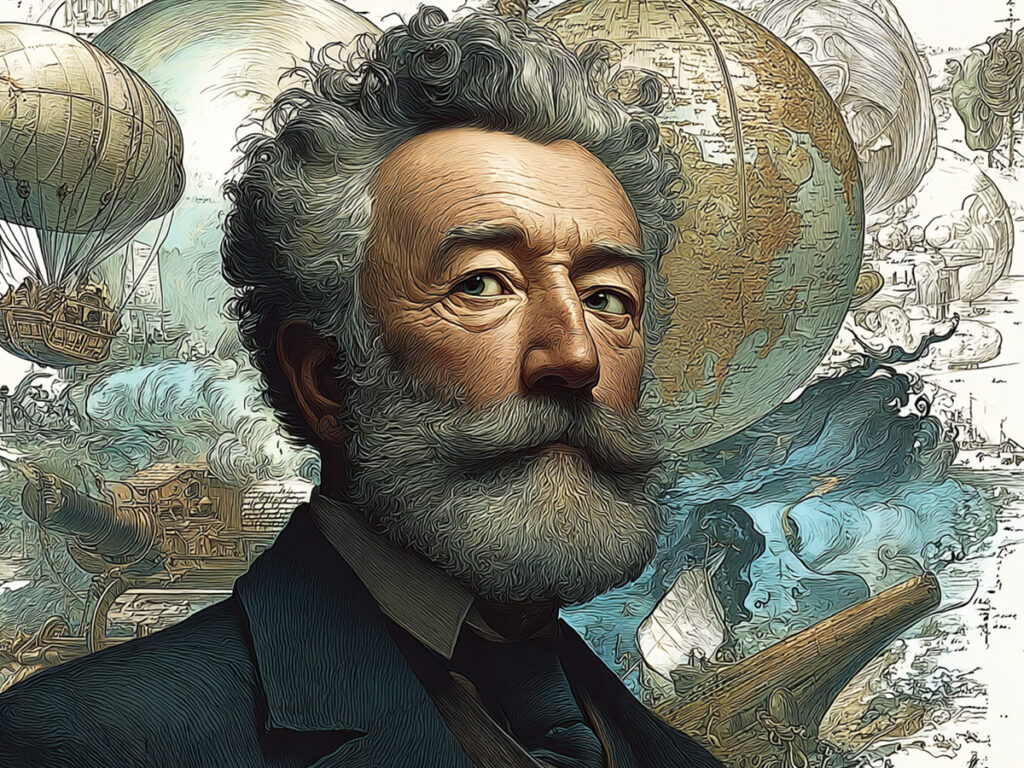
The Father of Science Fiction from Nantes
Jules Verne was born on 8 February 1828 in Nantes, into the family of lawyer Pierre Verne. He died on 24 March 1905 in Amiens, where he spent the final decades of his life as an acclaimed writer and city councillor. Today he is regarded as one of the pioneers of science fiction – the author who sent readers beneath the Earth, under the sea and into space.
The paradox of his biography lies in the fact that the creator of “voyage novels” spent most of his life at a desk. He worked methodically, for hours, day after day. Sea journeys and European travels were interruptions to this routine rather than its essence.
Childhood and the Famous “Runaway to Sea”
In 1839, eleven-year-old Jules allegedly signed on secretly as a cabin boy aboard the ship “Coralie”, bound for India. His father caught up with him in the port of Paimboeuf and removed him from the vessel. According to family legend, he ordered him from then on to “travel only in his imagination”.
Whatever the exact wording, the story perfectly foreshadows his later work. The motif of escape towards the unknown – the sea, outer space, distant lands – would return in his novels with the persistence of Captain Nemo.
A Lawyer by Diploma, a Writer by Calling
In accordance with his father’s wishes, Verne moved to Paris to study law. Formally, he was preparing for a legal career; in practice, he was writing plays and moving within literary circles.
His early adult years were not financially stable. He supported himself through small literary commissions and press collaborations. Choosing the path of a writer involved risk – particularly for the son of a middle-class lawyer.
The breakthrough came around 1862 with his collaboration with publisher Pierre-Jules Hetzel. Hetzel recognised in Verne an author capable of combining adventure with the popularisation of science.
Around the same time, his marriage to Honorine Morel played an important role. The financial stability and support this union brought allowed him to focus on writing. The career of a “visionary” was therefore made possible by very down-to-earth material conditions.
“Voyages extraordinaires” – Literature as an Encyclopaedia of the World
From 1863 onwards, Verne began publishing the series “Voyages extraordinaires”. His and his publisher’s ambition was to create a literary encyclopaedia of knowledge about the world.
In the following years, he wrote, among others:
- “Journey to the Centre of the Earth” (1864),
- “From the Earth to the Moon” (1865),
- “Twenty Thousand Leagues Under the Seas” (1870),
- “Around the World in Eighty Days” (1872).
This was not “pure fantasy”. Verne read scientific reports, followed technological developments and consulted specialists. He combined real geography and contemporary knowledge with literary projections of the future.
Verne the Sailor and the Yachts “Saint Michel”
Although he worked mainly at his desk, the sea remained his element. From the second half of the 1860s, he owned successive vessels named “Saint Michel”. The most famous – “Saint Michel III” – was a steam yacht adapted for writing.
He spent months each year on board. Voyages around Europe – to Great Britain, Scandinavia, Spain and Italy – provided not only rest but also observation and inspiration.
In 1867, he also travelled to the United States aboard the “Great Eastern”. He saw New York and Niagara Falls, experiences he later transformed into literature.
He was not an explorer crossing jungles and deserts. He was an attentive observer who knew how to turn real journeys into material for the imagination.
Discipline Instead of the Myth of the Visionary
Verne was known for iron discipline. He rose very early and wrote for several hours each day. For much of his career, he published at least one major novel a year.
Behind his success stood:
- systematic scientific reading,
- meticulous note-taking,
- editorial collaboration with his publisher,
- consistent organisation of work.
He was not a prophet of the future in the romantic sense. He was a diligent craftsman using imagination – and it carried him further than any ship.
The Shooting, Illness and Final Years
In 1886, he was shot in the leg by his nephew, who suffered from mental illness. The injury left him permanently disabled. With age, his eyesight and health deteriorated.
Despite this, he continued to write. In Amiens, he served as a city councillor from 1888 to 1903, engaging in infrastructure and cultural matters. His later works include “Master of the World” (1904) and “Invasion of the Sea” (1905).
Legends and the “Polish” Thread
Popular culture has preserved the legend that Verne was of Polish origin and born as Joel Olszewiec in Płock. Scholars consider this story a myth, although the writer himself never publicly denied it.
Legacy: Imagination Rooted in Work
Verne spent most of his life at a desk, bent over notes, maps and scientific reports. And yet it was he who taught readers to dream of ocean depths and space travel. His books continue to inspire those who seek to cross new boundaries – technological, geographical, intellectual.
His biography shows something more: great visions do not arise from chaos. They require work, support, stability and consistency. Before a book reaches a reader’s hands, it travels a long path – from idea, through manuscript, to physical copy.
Verne understood this process perfectly. Perhaps that is why his stories continue to sail on.
Sources:
- Jules Verne – Wikipedia
- Jules Verne – Biography & Facts – Encyclopaedia Britannica
- Dzieje.pl – article about legends concerning the writer’s alleged Polish origins