


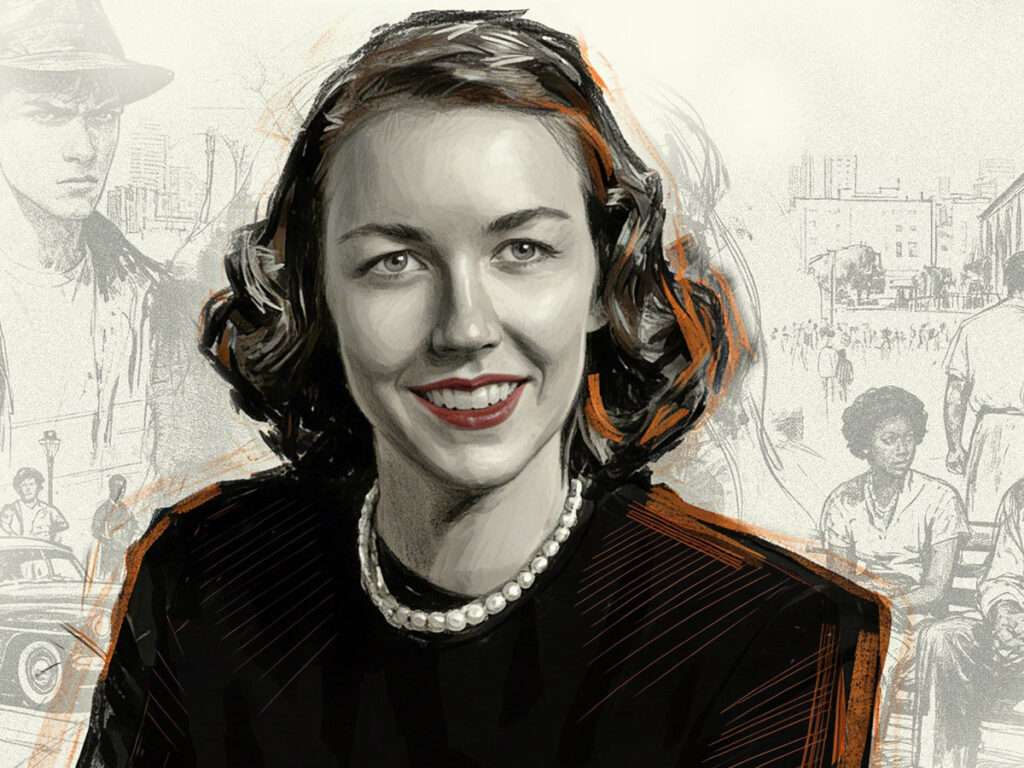
Who was Flannery O’Connor?
She belongs to a group of authors whose significance lies not in the number of pages they produced, but in their interpretative weight. A few dozen stories were enough for Flannery O’Connor to permanently reshape the way we think about short fiction.
Born in 1925 in Savannah, Georgia, she remained closely tied throughout her life to the American South – a region marked by a complex social and religious history. In her prose, this context is not merely a backdrop, but a space of tensions constantly demanding recognition.
After her studies, including at the prestigious Iowa Writers’ Workshop, she began her literary career, which was interrupted by illness. Lupus meant that she spent most of her life on the Andalusia farm in Milledgeville. She wrote in isolation, yet her texts remain remarkably precise – each one the result of deliberate control over form.
Southern Gothic literature – what does it really mean?
O’Connor’s work is most often associated with the Southern Gothic tradition. This is a variation of Gothic literature set in the realities of the American South. Instead of castles and ruins, we find provincial towns; instead of ghosts – social and moral fractures.
At the centre of this tradition are:
- racial and class tensions,
- the decline of the old Southern social order,
- religiosity confronted with violence and hypocrisy,
- characters who are excluded, distorted or “out of place”.
Among the key figures of this tradition are William Faulkner, Carson McCullers and Eudora Welty. O’Connor belongs to this lineage, yet she also radicalises it – above all through the intensity and condensation of form.
A world cracking open
Flannery O’Connor’s stories often begin almost mundanely. A family sets out on a trip, someone visits acquaintances, a casual conversation unfolds. These situations appear stable. Then, at some point, a crack emerges.
Not always immediately visible, sometimes only hinted at. But this is what drives the narrative. O’Connor does not build tension through spectacular plot twists. Her strategy is more subtle – she allows reality to gradually reveal its fragility.
That is why her stories often work with a delay. The strongest impact tends to come after the reading.

Violence as a moment of recognition
Violence is the most characteristic – and controversial – element of her prose. Yet it is important to be clear: in O’Connor’s work, it is neither an effect nor an ornament. It is a cognitive tool.
Her characters often operate in a state of self-satisfaction. They are convinced they understand the world, that they are in control, that they know who they are. A boundary situation, often brutal, strips them of that certainty. This is not about punishment, but about exposing a vulnerable core.
In this sense, her prose is deeply analytical. It captures the moments when we cease to act in predictable, controlled ways.
Grace that offers no comfort
Grace is a key category in O’Connor’s work. Not as a reward, but as an experience that disrupts the existing order. Her characters are rarely prepared for it. More often, they reject it or fail to recognise it. Yet the moment of disruption remains, giving meaning to the entire story.
This is why O’Connor’s work is often read as religious literature, though not in a conventional sense. She does not provide ready-made answers. Instead, she places the reader in a situation where uncomfortable questions become unavoidable.
The short form as a demanding discipline
One of the reasons O’Connor remains so important is her approach to the short story. Short fiction is often seen as “less significant”. In practice, it demands greater control over the material. A novel allows for digressions, expansions, dispersions. A short story does not. Every sentence must work.
O’Connor understood this perfectly. Her texts are constructed with exceptional precision. There is no room for accident. It is precisely this condensation that makes them so intense.
From controversy to influence
During her lifetime, O’Connor’s work provoked ambivalent reactions. Her craft was appreciated, yet the brutality and pessimism were criticised. For many readers, her Catholic perspective in a predominantly Protestant South was also difficult to accept.
Over time, however, her significance grew. Today, O’Connor is recognised as one of the central figures of 20th-century American literature, and her influence extends far beyond literature.
It can be seen in:
- the prose of Alice Munro and Joyce Carol Oates – particularly in their use of tension and short form,
- the work of Alice Walker, who explores similar social themes in a Southern context,
- the films of the Coen brothers – in their blend of dark humour, violence and moral ambiguity,
- contemporary narratives built around a sudden “crack” in reality.
This is not merely a stylistic influence, but a structural one – shaping the way stories are told.
Where to start with O’Connor?
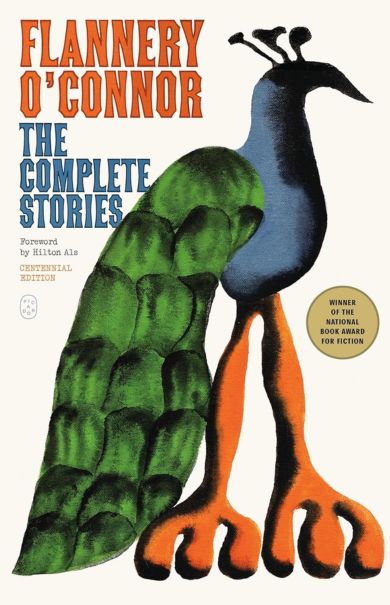
The best entry point remains “The Complete Stories (Centennial Edition)”. This collection offers a full view of Flannery O’Connor’s work. Across its range of texts, her method becomes clear: an ordinary starting point, mounting tension, and an ending that reshapes the entire story.
For readers who want to understand her world, one thing matters: do not look for comfort in these stories. They are not meant to reassure. They are meant to challenge something.
Conclusion
Flannery O’Connor wrote in a way that resists simple classification. Her work is at once realistic and grotesque, brutal and precise, restrained and intense.
It is literature that does not try to please the reader. Instead, it places them in a position where they must reconsider their own assumptions. Perhaps that is why we keep returning to her. And why she continues to inspire new generations of creators.
Sources: