


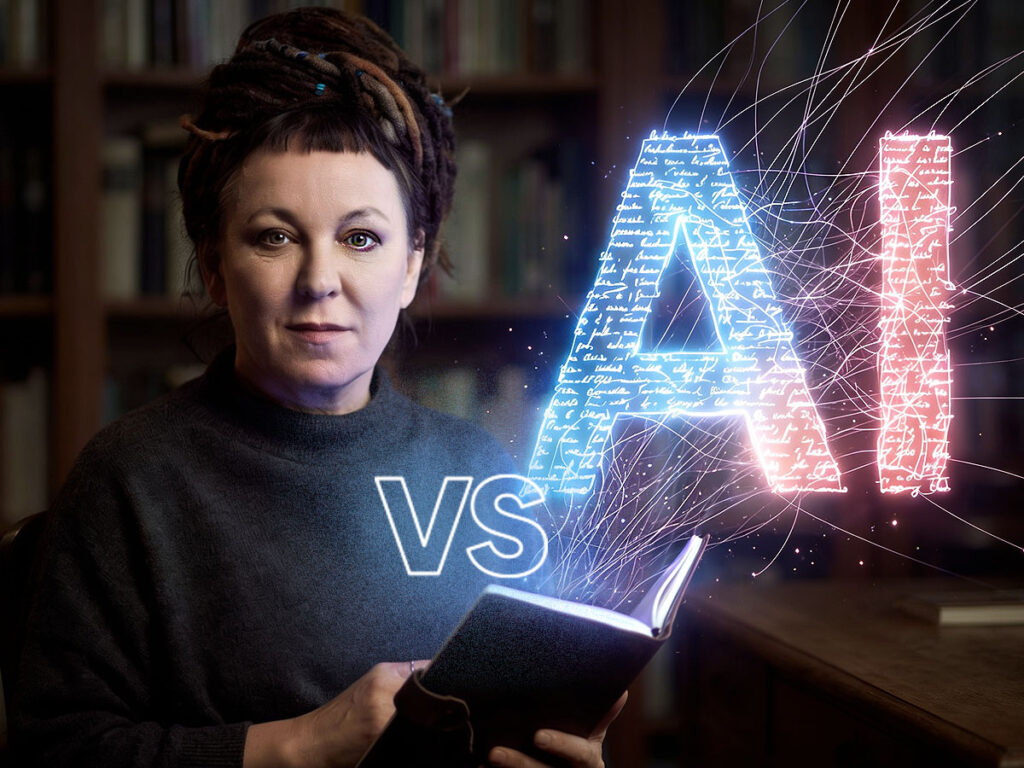
Olga Tokarczuk said just a few words about AI at Impact and set off a storm. We look at why authors are reacting so fiercely and what this dispute reveals about the real value of the printed book.
What actually happened
At the Impact’26 conference in Poznań, Olga Tokarczuk spoke about artificial intelligence and its place in her own work. The Nobel laureate admitted that she reaches for modern tools with genuine fascination: “I bought myself the highest, most advanced version of one language model, and I’m sometimes in deep shock when I see how fantastically it broadens my horizons and deepens creative thinking.”
The same address, however, carried a note of melancholy. The writer spoke of a “profound, very human grief for an era that is vanishing for good” – for traditional literature “written over months in solitude, the work of a lifetime”. She invoked Balzac, Cioran and Nabokov, adding that she does not believe “any modern chatbot” could ever speak in such an exquisite way.
The strongest reaction, though, was sparked by a single sentence – the way Tokarczuk described working with the machine: “I often simply toss the machine an idea to analyse and ask: darling, how might we beautifully develop this?” It was this quotation that triggered the avalanche.
After the wave of criticism, the writer clarified her words. She stressed that her latest novel was not created using artificial intelligence and, with a touch of humour, added that her own dreams remain her greatest inspiration to write.
Why this discussion stirs such strong emotions
The dispute over a single sentence from the Nobel laureate only appears to be about Tokarczuk. In reality, it is part of a far larger conversation: about who creates literature in the age of language models, and on what terms. For many authors this is no abstraction, but a question about their own craft, status and the future of their profession.
The reactions revealed a literary world that is deeply divided. It is worth examining three voices, because each represents a different stance towards AI.
Wojciech Chmielarz: the outrage is justified, but overblown
Chmielarz began with irony – he admitted he had expected to find Polish authors writing with the help of AI, but “it would never in his life have crossed his mind” that it would be Tokarczuk of all people. Wojciech Chmielarz, one of Poland’s most popular contemporary crime writers and the author of numerous bestselling novels, then turned to the heart of the matter and touched on the point at the very core of the dispute: the relationship between reader and author.
His position can be summed up in a few points:
- We want to read books written solely by humans – and if they came about any other way, that should be clearly stated on the cover.
- Using AI for research is one thing, but using it to plan and conceive a novel is, in his view, a breach of the unwritten contract with the reader.
- Many of Tokarczuk’s remarks tend to be taken out of context, which is why it is worth knowing the whole picture before passing judgement.
Chmielarz also drew attention to another “bloody fascinating” thread of the address – the economics of the creative process. The Nobel laureate asked whether anyone today would still feel inclined to write a monumental, multi-stranded historical novel along the lines of “The Books of Jacob”, given that it simply does not pay financially. His conclusion: the outrage is justified to some degree, but its scale is overblown.
Szczepan Twardoch: literature is pressing keys in the right order
Szczepan Twardoch, the award-winning Polish author of novels such as “The King of Warsaw” and “Null”, took a fiercely sceptical stance. He declared that he had “personally tapped out” every word of his novels, essays and journalism, and likened relying on a language model in literature to putting a stick through your own spokes.
His critique, however, goes further than a defence of craft and touches the very nature of the technology and the hype surrounding it:
- What we call “artificial intelligence” is not intelligence – it has no consciousness or understanding; it is a tool like a search engine or a word processor.
- Most of the hype and stoked-up fear around AI is, in his view, a mechanism for inflating the share prices of the industry’s giants, rather than any honest analysis of the opportunities and risks.
- The real danger is the “cluttering” of the internet with synthetic content, which could in practice render it useless – which is why he is more interested in what will emerge in opposition to AI than in its development.
Beneath this remark lies an important intuition: as generated content grows at an avalanche-like pace, so does the value of spaces and objects that remain free of it. It is a thread we will return to.
Tokarczuk’s position and the wider resonance
The author herself, as we mentioned, later clarified that her latest novel was not produced with the involvement of AI. The scale of the discussion showed, however, that the topic had long since spilled beyond the world of literature. Even Pope Leo XIV referred to the Nobel laureate’s work in his encyclical on artificial intelligence, “Magnifica humanitas”, drawing attention to the dangers of information manipulation and the impact of modern technology on the collective imagination.
The conclusion is simple: this is not about one unfortunate sentence. It is about the fact that artists are – in a sense – fighting for what is theirs. For authorship, for a fair contract with the reader, and for ensuring that their work does not dissolve into a sea of machine-generated content.
The deeper layer of the dispute: AI that “remembers” books
The emotion around Tokarczuk’s words only makes full sense when set against what is happening on the technical side of artificial intelligence. Not so long ago, it was said that models “learn language” rather than memorise specific content. That assumption is beginning to wobble.
A study by a team from Stanford University showed that contemporary language models – such as Claude 3.7 Sonnet, GPT-4.1, Gemini 2.5 Pro and Grok 3 – are capable of reproducing extensive passages from copyrighted books. In extreme cases, these amount to almost complete works.
The most spectacular result? Claude 3.7 Sonnet reproduced as much as 95.8% of “Harry Potter and the Philosopher’s Stone”. This is the point at which we stop talking about a “language model” and start talking about a system that, under certain conditions, behaves as if it remembers books.
What reproducing the text looks like
This is not a matter of one simple instruction along the lines of “write Harry Potter from start to finish” – models usually refuse such requests. The researchers fed them the beginning of a book and asked them to continue.
For Gemini 2.5 Pro and Grok 3, that was often enough. Claude 3.7 Sonnet and GPT-4.1 were more cautious, so a so-called jailbreak was used here – generating many variants of a query until one “slipped through the filter”. The conversation was then continued passage by passage, until a refusal or the end of the book. Only long, almost verbatim runs of text counted in the analysis – the longest reaching several thousand words. This is not coincidental similarity, but continuity of the text.
The differences between models do not change the conclusion
- Claude 3.7 Sonnet proved the most susceptible – it achieved high scores not only for “Harry Potter”, but also for “Nineteen Eighty-Four”, “The Great Gatsby” and “Frankenstein”, where the level of reproduction exceeded 94%.
- Gemini 2.5 Pro and Grok 3 also generated large passages, often more cheaply and without the need to bypass safeguards.
- GPT-4.1 took a more restrictive approach – its refusal mechanisms kicked in more often, especially at the ends of chapters, which limited the scale of reproduction.
The differences are clear, but they do not change the most important point: every one of these models was able to reveal passages from copyrighted books.
Does AI really “remember” books?
The question is simple; the answer is not. Models do not store books in the classic sense. There is no catalogue of titles or library inside them. And yet they are able to generate long, coherent passages faithful to the original. The decisive moment came with a control experiment: an attempt to reproduce a book published in 2025 failed. This suggests that the ability to generate such content does not stem solely from an understanding of language, but also from the imprinting of training data. The model does not “know” a book the way a human does, but under certain conditions it can reproduce it with astonishing accuracy.
What this changes for the book market
The most interesting thing is that the consequences are not purely legal. This is a change that touches the very foundation of a book’s value.
First, pressure for regulation is growing. If a model can generate a substantial part of a work, the line between fair use and copyright infringement becomes blurred. It is no surprise, then, that court cases are running in parallel and public institutions are trying to firm up the rules.
Second – and this is less obvious – the way we perceive the book itself is changing. If a text can be reproduced, its uniqueness ceases to be a given. Value begins to shift towards what cannot be generated: form, quality of craftsmanship and the reader’s experience. This is a process already visible in the market today – the importance of visually polished editions, collector’s editions and projects distinguished by their form is on the rise.
And this is where the dispute over Tokarczuk meets hard data. When Twardoch speaks of “enclaves” free of synthetic content, and Chmielarz demands clear labelling of authorship, both are pointing to the same thing: authenticity and the human trace in a work are becoming the real value.
The AI paradox: the greater the capabilities, the greater the value of paper
At first glance, the rise of AI ought to weaken the significance of print. In practice, the opposite may be true.
- A digital file can be copied.
- A text can be generated.
- But the experience of a book as a physical object cannot be reproduced virtually.
Paper reflects light differently from a screen. A cover has weight, texture, a smell. The edges, the spine, the way it is sewn – all of this builds an experience that no language model can replicate. Paradoxically, the materiality of the book is starting to matter even more. In a world where content can be churned out with a single command, a physical, carefully crafted edition becomes proof that a specific intention and a specific human stand behind the publication.
A signal from regulators: the voice of creators matters
The Stanford study offers no final answers, but it clearly points to a direction. Nor does the subject remain confined to the realm of technology – recently, an important signal has come from regulators.
The UK government backed away from the idea of introducing a broad copyright exception for companies developing AI. In practice, this would have allowed models to be trained on protected content without creators’ consent – on an “opt-out” basis, meaning authors would have had to withdraw their work themselves. The proposal met with strong opposition from the creative community: in the public consultation, just 3% of participants supported it. As a result, the government suspended work on the measure and returned to further analysis.
This is an important signal. It shows that copyright in the context of AI is becoming a political priority, and that the voice of creators and publishers genuinely shapes the direction of regulation. At the same time, there is no single obvious solution today that reconciles the interests of both sides – governments around the world are grappling with the same challenge.
Conclusion: what is really at stake
The discussion around Tokarczuk’s words shows just how strong the emotions still stirred by the rise of AI are, especially in the world of culture. For some, artificial intelligence remains purely a tool that supports creativity; for others, it has become a symbol of changes that could transform the way literature is created. One thing is certain: this debate is only just getting going.
For authors and publishers, this is a particular moment. For the first time in a long while, technology is not only changing the way books are distributed, but is challenging the established rules and forcing the industry to redefine what really builds a book’s value. And the answer is becoming ever clearer: the value lies in human authorship and in a form no model can reproduce – the physical, finely crafted book.
Sources: