


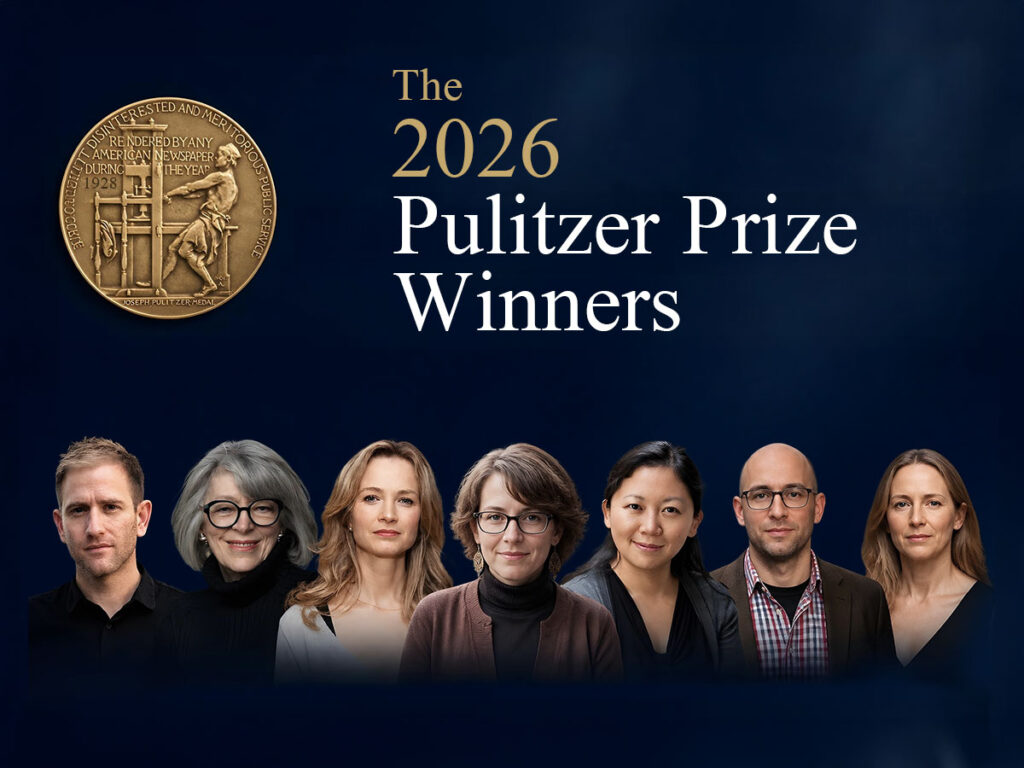
Every year, without fail since 1917, Columbia University announces the names of the Pulitzer Prize winners. For American journalism, literature and music, these honours have become what the Oscars are to cinema. For publishers, authors and readers around the world, the jurors’ verdict is not merely a list of titles worth noting; it is also a moment that reveals, with real clarity, what books are being written about today, how they are being written, and which of them stand a chance of passing the test of time.
This year’s decisions in the literary categories bring together a mix of familiar names and debut talents, of genre fiction and demanding non-fiction. We take a look at them one by one – with an emphasis on what English-language readers can already pick up today.
What the Pulitzer Prize is and why it still matters
The award was endowed through a bequest from Joseph Pulitzer, a newspaper publisher who, at the dawn of the twentieth century, wanted to champion rigorous journalism and ambitious creative work. The first prizes were handed out in 1917, and today they are awarded across more than a dozen categories: from investigative reporting, through fiction and poetry, to music.
Although the Pulitzer remains a predominantly American honour – chiefly recognising writers and journalists from the United States – its reach is global. Winning titles land on bestseller lists, enter publishers’ catalogues in dozens of countries, and are eagerly translated into other languages. For the publishing trade it is also a signal: here are the books worth reissuing and reprinting in line with demand.
Fiction: “Angel Down” by Daniel Kraus
In the fiction category, the prize went to the novel “Angel Down” by Daniel Kraus, published by Atria Books. Kraus is an author known for his ability to blend genre conventions with weightier reflection. The award in this category confirms that the jurors are increasingly happy to reward prose that is unafraid to reach for tension, the uncanny and a strong, gripping narrative rhythm.
A Pulitzer win tends to widen a novel’s reach almost overnight. For a writer like Kraus, who has built a following across both fiction and screen work, the honour is the kind of impulse that draws fresh readers to the title and sends booksellers reaching for new stock.
History: “We the People” by Jill Lepore – a writer well worth discovering
The history category was won by Jill Lepore and her “We the People: A History of the U.S. Constitution” (Liveright). Lepore is one of America’s most recognisable historians, a Harvard professor and a regular contributor to The New Yorker, celebrated for her gift of writing about the past in a way that is accessible yet rigorous.
English-language readers already have a rich back catalogue to explore. Her sweeping single-volume history of the United States, “These Truths: A History of the United States”, became a widely praised bestseller and remains a natural starting point. If this year’s verdict has caught your interest, her earlier work is the perfect place to begin getting to know Lepore.
Biography: the Schuyler sisters in an age of revolution
The prize in the biography category went to Amanda Vaill for “Pride and Pleasure: The Schuyler Sisters in an Age of Revolution” (Farrar, Straus and Giroux). The book reconstructs the lives of the Schuyler sisters – women who lived through the era of the American Revolution and whose biographies are interwoven with the story of a nation in the making.
It is a subject that found a wide audience following the success of the musical “Hamilton”, yet Vaill approaches it with the craft of a biographer: she draws on primary sources, reconstructs everyday life, and shows the era from a frequently overlooked female perspective.
Drama: “Liberation” by Bess Wohl
In the drama category, the honours went to the play “Liberation” by Bess Wohl, published by Concord Theatricals. Wohl is a highly regarded American playwright, and the award-winning text belongs to a strand of theatre that pairs a personal, family-centred perspective with questions about freedom, identity and generational change.
Memoir and autobiography: Yiyun Li – an author already well known to English-language readers
The memoir and autobiography category brought the prize to Yiyun Li for “Things in Nature Merely Grow” (Farrar, Straus and Giroux). This is deeply personal prose, grappling with the experience of loss, written with the restraint and precision so characteristic of the author.
Yiyun Li, born in Beijing and writing in English, has long been a fixture of contemporary literary fiction. Her debut short-story collection, “A Thousand Years of Good Prayers”, won early acclaim, while novels such as “Must I Go” have cemented her reputation among readers and critics alike. These are titles through which you can get to know this year’s laureate’s work before turning to the award-winning memoir itself.
General Nonfiction: “There Is No Place for Us” by Brian Goldstone
In the General Nonfiction category, the prize went to Brian Goldstone for “There Is No Place for Us: Working and Homeless in America” (Crown). It is a piece of reportage that confronts one of the most painful paradoxes of contemporary America: the homelessness of people who have jobs yet are still unable to keep a roof over their heads.
Goldstone combines the rigour of investigative reporting with genuine empathy for his subjects. This is the kind of non-fiction that does not stop at the statistics but instead brings concrete human stories to light.
Poetry: “Ars Poeticas” by Juliana Spahr
The laurels in poetry went to Juliana Spahr for her collection “Ars Poeticas” (Wesleyan University Press). Spahr is a poet known for experimenting with form and for her strong social and political engagement. The very title – echoing the classical genre of meditations on the art of poetry – heralds a collection that is at once a poem and a reflection on what a poem can be today.
What this verdict tells us about the book market
This year’s list of winners offers a useful map of reading trends: a strong showing for non-fiction and reportage, a return to history told in an accessible way, and personal prose that wrestles with loss and memory. For publishers and authors it is also a reminder that an award-winning title can sharply boost interest – and, with it, the demand for reprints and new editions.
It is in precisely this context that digital book printing reveals its advantage: it makes it possible to respond to a sudden surge in demand without the risk of tying up capital in large print runs. When a laureate’s name hits the front pages, response time is everything, and the ability to reprint exactly as many copies as you need can be the difference between an opportunity seized and one lost.
Sources: