


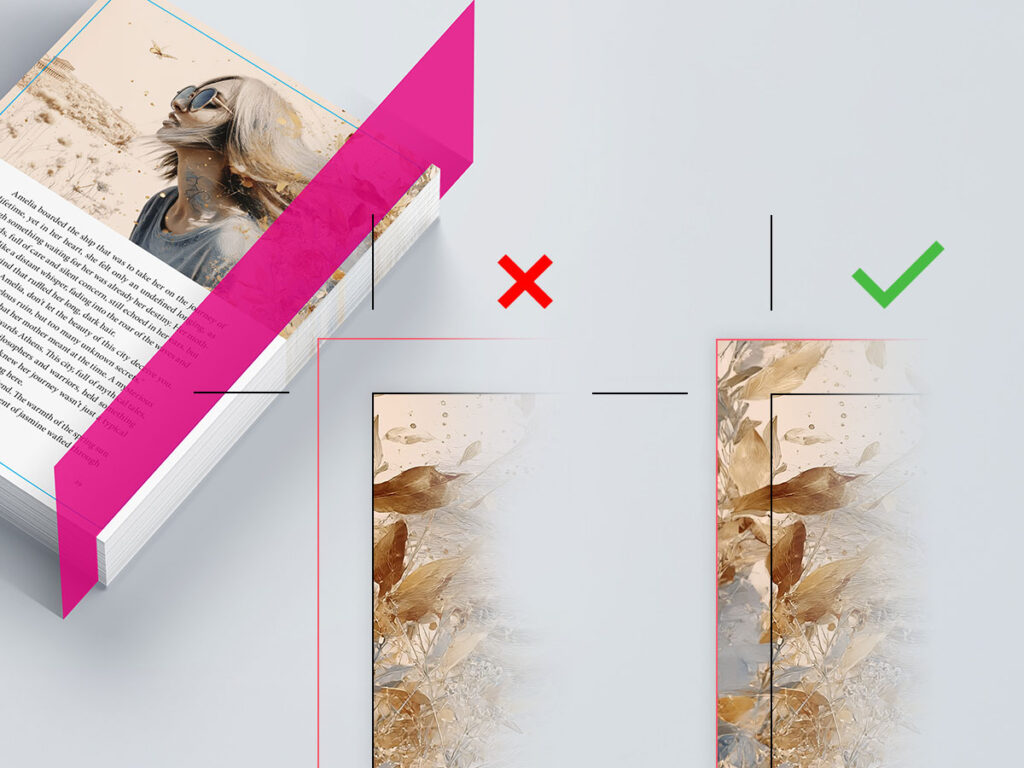
One of the key elements determining the professional look of a printed book is bleed. Maintaining it allows for a satisfactory visual effect and avoids the situation where part of the publication is poorly trimmed, resulting in unsightly white strips. In this article, we will discuss what bleed is, what value it should have, and the purpose of using it in the printing process.
What is print bleed?
What are print bleeds? These are graphic areas that extend beyond the target (net) edge of the publication. Their width usually oscillates between 3 and 5 millimetres (mm). This is the space that will be cut off during the binding process.
In practice, this means the gross file (total print area) should be at least a few mm larger on each side than the final version of the printed project (net format). Thanks to this, after trimming unnecessary spaces, we avoid characteristic white strips on the sides and simultaneously lose none of the presented content.
What role does bleed play in a publication prepared for printing?
The main role of bleed is to guarantee that backgrounds or graphic elements reaching the page edge (so-called printing to the edge) look professional after trimming. Bleed is an area ‘for trimming’. Since the guillotine cutter has a tolerance of up to a few millimetres, bleed ensures that even with a minimal knife shift, unsightly white strips do not appear on the publication edges.
Remember, bleed is not an area for protecting important content (like text or logo) from being cut. For that, there is the safety margin, an area where all essential elements should be placed.
Using bleed also means that in the printing process we deal with:
- gross format, which includes bleed, i.e., space that will be cut off after printing,
- net format, which constitutes the final size of the publication, i.e., after processing.
Bleed and project realization at the printing house
Viewing a PDF on a computer screen, one can easily review the entire project content. It looks slightly different from the printing house’s perspective. It may turn out that a file looking perfect in the digital version will be sent back for correction. A common reason for such rejection is improperly set bleeds in the block or their absence.
As a result, on the project:
- a white frame is visible,
- an unsightly white frame appears along one or several edges (because the guillotine did not hit the project edge perfectly),
- if the project did not have safety margins maintained either, essential information (e.g., text or logo) could additionally be cut off.
It is also worth remembering that the bindery guillotine cuts a whole stack of sheets simultaneously. Even with the highest machine precision, during cutting of a thick paper stack, there is always a minimal cutting tolerance (micro-shifts), sometimes reaching 1-2 mm. Therefore, correct bleed setting will have such a significant impact on the entire realized project.
Incorrect bleed setting – consequences
An error in bleed setting can carry serious consequences. If a project with such a defect goes to print, the entire batch prepared this way may be rejected. This, in turn, means costs of lost material, as well as the necessity to prepare the correctly formatted print again.
Therefore, at Books Factory, already at the stage of ordering books in the calculator, you must specify whether your file was prepared with bleeds or without them. This allows us to properly verify the project. If yes, the gross sheet format will be slightly wider.
Bleeds in the block and the Books Factory offer – what is worth knowing?
Ordering project realization at Books Factory, our clients have transparent calculators at their disposal, enabling the choice of blocks with or without bleeds. This option applies to:
- softcover books,
- hardcover books,
- softcover board books,
- hardcover board books,
- saddle stitched books (booklets),
- Wire-O books (softcover),
- Wire-O books (hardcover).
Choosing a block with bleeds is recommended when, in the project prepared by the client, the background or graphic elements comprising the publication reach the very edge of the page. In this case, setting a bleed of 3 mm width is necessary.
In practice, this means that 6 mm should be added to the net format of the book, i.e., 3 mm on each of the four sides. Therefore, if the format of the book ordered by you is to be 148 × 210 mm, the gross file (with bleeds) should have the format 154 × 216 mm (because 148 + 3mm + 3mm = 154 mm and 210 + 3mm + 3mm = 216 mm).
To sum up, print bleeds are a key technical element of the project. It is an additional area (usually 3-5 mm) around the net format, onto which all graphic elements (backgrounds, photos) that are to reach the very edge should be extended. This area is intended for trimming and guarantees that the finished publication will look professional, without white strips. Thanks to them, our client can be sure that the realization performed by us will meet their expectations.
Check Books Factory and explore our offer
You already know how crucial bleeds are for print quality. Use this knowledge and go to our print calculator. In a few moments, you will configure the order, choose appropriate options (e.g., block with bleeds) and find out the exact cost of realizing your project.
Go to Books Factory print calculator.
We also encourage you to read other blog entries where we describe the process of preparing books for printing.