


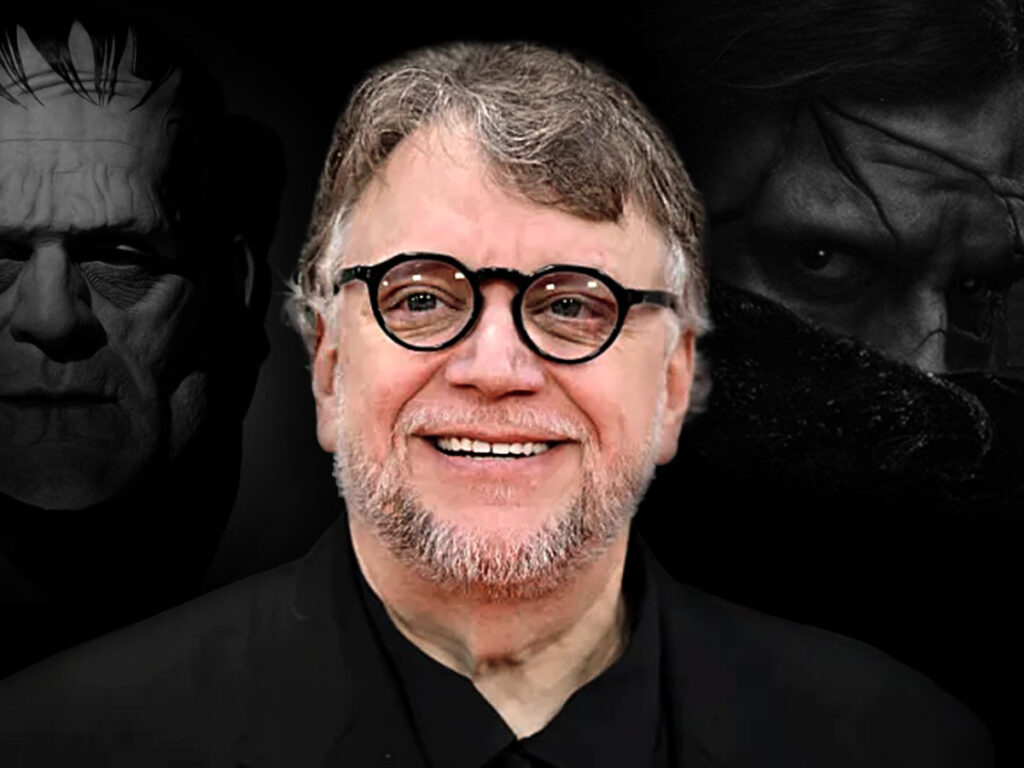
Guillermo del Toro has claimed for years that Frankenstein would be his opus magnum. The November premiere brought a spectacular work, but does it fulfil the high hopes placed upon it? As printing and literature enthusiasts, we took a close look at this production.
A Gothic Fairytale in Colour
Del Toro offers a vision far removed from Gothic gloom. Instead of dirt and greyness, the director serves a visual feast full of saturated colours and strong contrasts. Particularly striking is the vivid red of the blood, which is almost hypnotic against the cooler scenery, and the character of Elisabeth—heavily stylised, appearing almost as if lifted from Pre-Raphaelite paintings.
It is worth appreciating that most of the set design was actually built, which seems a rarity in the age of ubiquitous CGI. However, the specific, ‘soft’ lighting sometimes makes these impressive film sets lose their authenticity. The ‘fairytale realism’ that worked so perfectly in
Jacob Elordi as the Monster – Statuesque Melancholy
The greatest challenge of any adaptation is visualising the Creature. Del Toro, aware of the pop-culture legacy of Boris Karloff weighing on the project, decided to break with the image of the lumbering monster.
Jacob Elordi in the role of the Monster is an intriguing creation.
- His character arouses fascination rather than disgust—the make-up exposes the joins and stitches, yet the Creature’s body is almost statuesque.
- He recalls the performance of Rory Kinnear—fans of the series Penny Dreadful will spot the similarity in approach to the character: this is an intelligent, melancholic being.
- He can also be pure fury—when the Monster loses his composure, melancholy gives way to destructive power.
It is in this character that the attempt to return to the roots and erase the stereotype of the ‘stupid monster’ cemented in the cinema of the 1930s is most visible.
Action vs Philosophy. Where Did Mary Shelley’s Spirit Go?
Although the 2025 Frankenstein tries to be faithful to the book regarding the Creature’s intellect, Hollywood has claimed its rights. The film suffers from unnecessary insertions straight out of superhero cinema. Scenes where the Monster tears people apart with his bare hands and charges like the Hulk clash with the subtle fabric of a story about rejection.
Nevertheless, moral dilemmas are present here. They resonate most strongly in the Creature’s relationship with the Blind Man. The scene in which the old man speaks the words “you are my friend” is one of the few moments where visual opulence gives way to pure emotion. Equally moving is the sequence in which the being asks Victor to create a companion—here we hear most clearly the echo of the questions Mary Shelley posed: who is truly the monster here?
A Detail that Delights: Books and Journals
As print specialists, we could not take our eyes off the props. The physical journals of Victor Frankenstein (played by Oscar Isaac) were crafted with extraordinary reverence. We see distressed bindings, yellowed paper, and complicated handwritten notes. The old anatomical plates look equally impressive. This is proof that the physical book remains a powerful symbol of knowledge.
Verdict: A Spectacle Without a Heart?
Has Guillermo del Toro delivered the Frankenstein of all time? Unfortunately, it seems the final result does not quite match the ambitions. The film is visually stunning, but in this riot of colour, the relationships between the characters have been lost somewhere. The triangle of Victor–Elisabeth–Monster often remains simply cold.
For lovers of the classics, the 1994 version (with Robert De Niro) remains the unsurpassed benchmark. However, for younger generations, Rory Kinnear’s interpretation and the Frankenstein plotline from Penny Dreadful will feel more ‘alive’. Del Toro gave us a beautiful picture but forgot that what is most important in Frankenstein is invisible to the eye.