


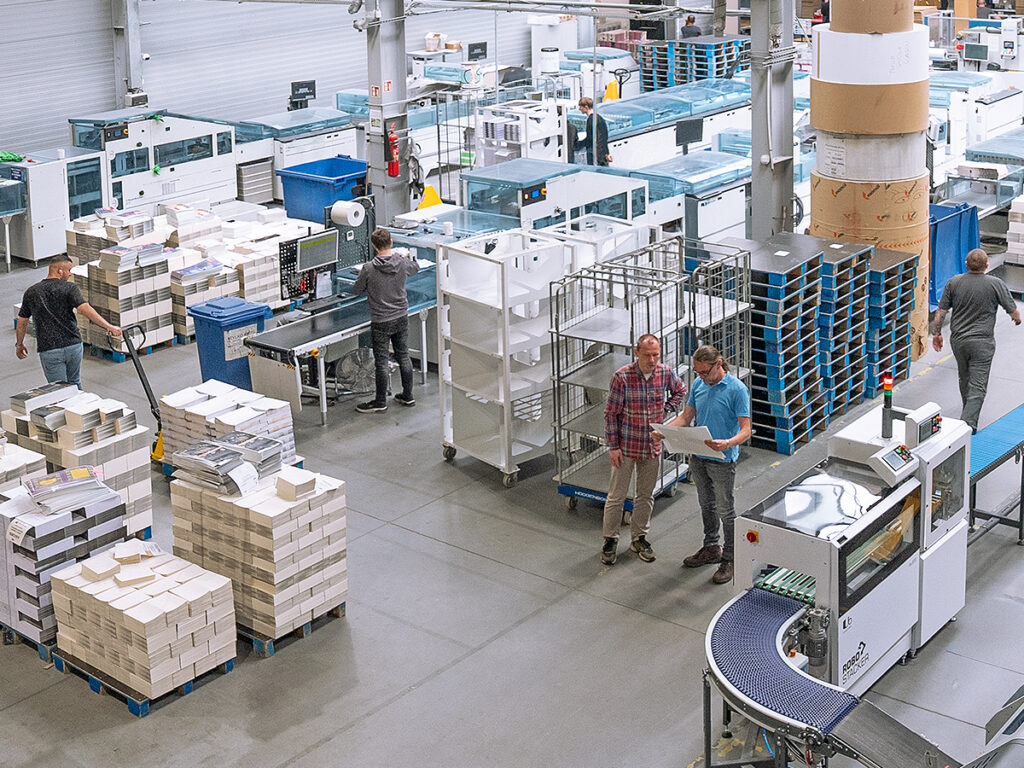
The modern printing industry is a highly advanced technological ecosystem. Even in 2026, with automation and artificial intelligence supporting many processes, skilled professionals remain the true guarantee of a high-quality final product. Many clients ordering books or catalogues wonder who actually works in a printing house—and how complex the journey is from a digital file to a physical object.
Each publication is the result of close collaboration between multiple specialists, each playing a distinct role in the production chain. Printing house roles are designed to eliminate errors at every stage—from file verification and ink application to final binding and trimming.
DTP Specialist – the first step in the printing process
Before a project reaches the press, it must be properly prepared by a DTP (Desktop Publishing) operator.
This is the first person to review the materials provided by the client. The DTP specialist checks whether the files are correctly prepared for print. In practice, this involves verifying a range of technical details—from image resolution and correct CMYK colour settings to proper bleed, margins, and embedded fonts.
The DTP operator also prepares the imposition—the arrangement of pages on a production sheet or within the press format. This ensures that after printing, folding, and trimming, all pages appear in the correct order.
Although DTP work is carried out mainly at a computer, it has a significant impact on the final result. A well-prepared file prevents many issues in later stages of production.
Printer – the core of the production process
Once the files are ready, they move to the production floor, where the printer takes over. This is one of the most characteristic roles in the printing industry. Key responsibilities include:
- setting up the machine with the appropriate parameters,
- supervising the application of ink or toner to the substrate,
- ongoing quality control and colour consistency checks against reference sheets,
- maintaining and servicing the printing equipment.
In modern facilities such as Books Factory, printers use advanced spectrophotometers that enable mathematically precise colour reproduction. Yet even with technological support, it is the trained human eye that detects subtle nuances machines may miss.
Bookbinder – the craft behind the final form
After printing, the sheets move to the finishing department, where the bookbinder gives the publication its final shape.
This is one of the most traditional yet versatile roles in the industry. In modern printing houses, craftsmanship is combined with operating binding lines for perfect binding, sewn binding, or spiral binding.
Bookbinding tasks include:
- folding sheets into the final format (folding),
- gathering signatures and preparing them for binding into a book block,
- laminating (applying protective film), adding coatings or metallic foils,
- attaching covers and ensuring the aesthetic quality of the spine and endpapers.
Without the precision of the bookbinder, even perfectly printed pages would not form a durable, functional book. At this stage, every millimetre matters—errors in binding are usually irreversible and can compromise the entire production.
Guillotine Operator – precision cutting
One of the most critical stages in post-press processing is trimming. Here, the key role is the guillotine operator. Despite its name, the guillotine is a highly advanced, computer-controlled machine capable of cutting stacks of paper with sub-millimetre accuracy.
The operator’s responsibilities include:
- preparing cutting programmes according to technical specifications,
- ensuring proper paper clamping to prevent shifting,
- monitoring blade sharpness, which directly affects edge quality,
- maintaining cleanliness and preventing mechanical damage to finished products.
A precise guillotine operator ensures perfectly even edges and formats that match the design. This role requires responsibility, precision, and composure when working with cutting equipment.
Synergy and quality control – who else works in a printing house?
When discussing who works in a printing house, it is important not to overlook the supporting departments that keep the entire organisation running smoothly. Beyond production specialists, these include sales teams, logistics, warehousing, HR, accounting, marketing, and R&D teams responsible for technological development and process optimisation.
Modern printing is a team effort. If a designer makes a mistake in file preparation, the printer cannot achieve the desired result. If the bookbinder lacks precision, the guillotine operator’s work may be compromised. That is why communication and mutual understanding across departments are essential.
Understanding the number and diversity of roles involved helps clients appreciate the value of the final product. Behind every book you hold in your hands stands a team of professionals who have invested their time and expertise to achieve a satisfying result. At Books Factory, we combine advanced technology with the passion of our specialists—building trust among publishers and authors across Europe.
Summary – human expertise at the heart of printing
Despite the rapid development of digital technologies, the human role in printing remains irreplaceable. Experience, intuition, and attention to detail are what transform printing into a craft. Each printing professional contributes something unique—from the mathematical precision of DTP, through knowledge of inks and printing processes, to the craftsmanship of bookbinding.
By choosing a professional printing house, you are choosing a team of people for whom quality is not a slogan, but a daily standard. This synergy of expertise ensures that printed books continue to thrive—offering readers a lasting and tangible aesthetic experience.
If you would like to learn more about our team, we invite you to visit our careers page.