


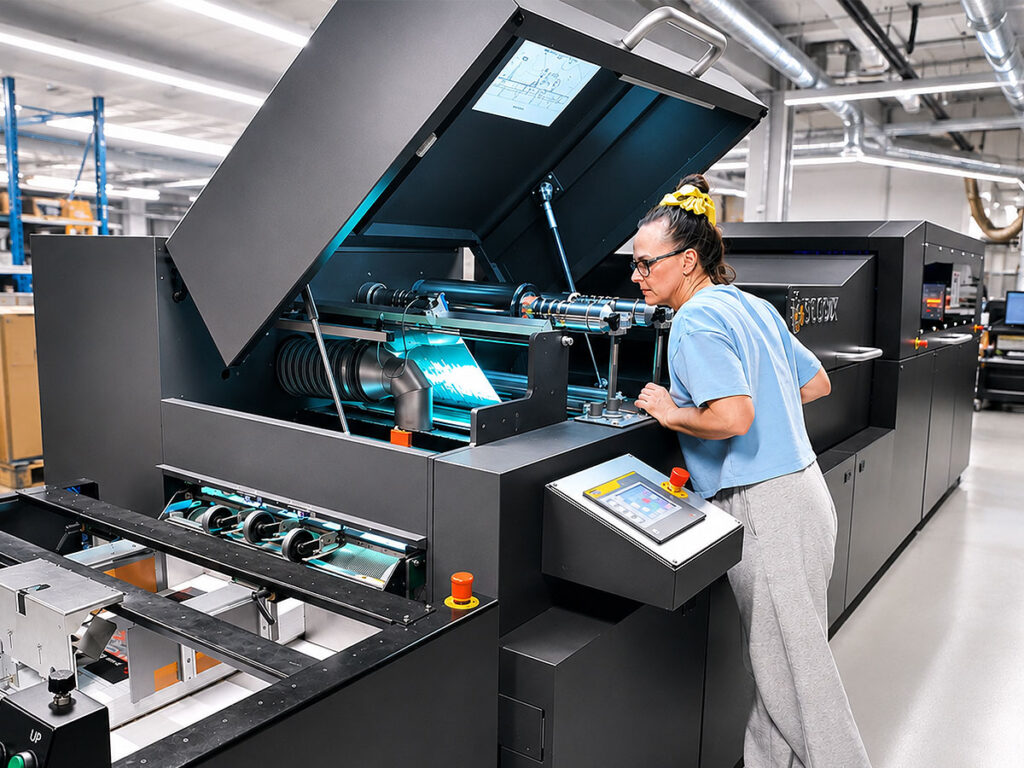
A bookbinder is a craftsperson and finishing-process technologist who transforms printed sheets into a ready-to-use product – a book. Their work involves cutting, folding, sewing or gluing book blocks, and joining them to covers, all while ensuring mechanical durability and visual appeal.
In this article, we take a closer look at what a bookbinder does and why their role in modern print production is absolutely vital.
Who Is a Bookbinder and What Is Their Role?
The word “bookbinder” speaks for itself – it describes someone who binds books. Historically, the craft involved hand-stitching sheets of paper and encasing them in leather or cloth.
Today’s bookbinder operates advanced machinery, yet still needs an in-depth understanding of materials such as paper, board, adhesives and foils.
Without the bookbinder, the publishing process would grind to a halt at the stage of printed stacks of paper. It is precisely at this point that a publication receives its final form – made not only to look beautiful, but above all to be functional and long-lasting.
What Does a Bookbinder Do in Day-to-Day Practice?
What does a bookbinder actually do? In small artisan workshops, it may mean painstaking hand-work restoring antique volumes. In large industrial operations, the bookbinder focuses on supervising automated processes. Their core tasks include:
- preparing printed sheets for further processing by trimming them to precise dimensions,
- folding sheets into signatures of a specified format,
- collating signatures in the correct order to form a cohesive book block,
- joining the book block to the cover by thread sewing or adhesive binding,
- enhancing cover surfaces through lamination, foil application or embossing,
- producing specialist bindings such as spiral or saddle-stitch formats.
Every one of these stages demands close attention. A mistake at the binding stage can undo all the work previously carried out by designers and press operators. Precision, therefore, is the single most important quality.
How Bookbinding Works – The Production Process
To understand how bookbinding works, it helps to follow the journey a book takes from the moment it leaves the printing press. Post-press finishing consists of several phases. The first stage is cutting and post-print processing. Depending on the production technology, both programmable guillotines and integrated block-processing lines are used – systems such as the Hunkeler Bookline or Horizon SmartStacker/HT. Final three-sided trimming of the finished block is carried out on three-knife trimmers (e.g. Horizon HT-1000, Muller Martini Granit).
The pivotal moment in the binding process is the creation of the book block. Depending on the chosen technology, the block can be assembled using various methods. For thin publications such as brochures and catalogues, saddle stitching (wire stitching) is used, carried out on automated gathering and stitching lines – for example, Duplo systems.
For thicker books, thread sewing is employed on industrial signature-sewing lines (such as Meccanotecnica’s Universe systems). This method delivers outstanding durability and allows the publication to open comfortably without the block breaking apart.
An alternative is adhesive binding, carried out on perfect binders equipped with EVA (hotmelt) or PUR gluing systems. PUR adhesives offer high flexibility and mechanical resistance, making them particularly well suited to heavier-weight papers and publications that will see intensive use.
The final stage is casing the block into its cover – for softcover editions this is done on perfect binders; for hardcover editions, on casing-in lines (e.g. Muller Martini Diamant). Hardcover binding requires a laminating process in which the covering material is permanently bonded to binder’s board to create a rigid case, followed by the precise tipping-in of endpapers that connect the interior of the book to its outer casing. The entire assembly must then be pressed to prevent material distortion.
Finishing Refinements – Adding Value and Durability
Once the binding is complete, a book may undergo additional finishing processes that improve both its appearance and its mechanical resilience. Depending on the design brief, refinements can reinforce the cover, protect it against scuffing, or lend the publication a more prestigious character.
The most commonly applied processes include:
- cover lamination (film laminating), which increases resistance to scratches and moisture,
- UV varnishing (flat or 3D), highlighting selected graphic elements,
- hot-foil stamping (digital or traditional), creating a metallic sheen,
- die-cut windows in the cover or edge printing of the book block, helping the publication stand out on the shelf.
In modern digital print facilities, these processes are carried out on specialist digital enhancement systems – solutions from Scodix, MGI and Duplo – enabling the application of textured varnishes and metallic effects without conventional dies.
Well-chosen finishing refinements are far more than decorative touches – they are a deliberate tool for positioning a book as a premium product.
Key Responsibilities of a Bookbinder in a Modern Print Facility
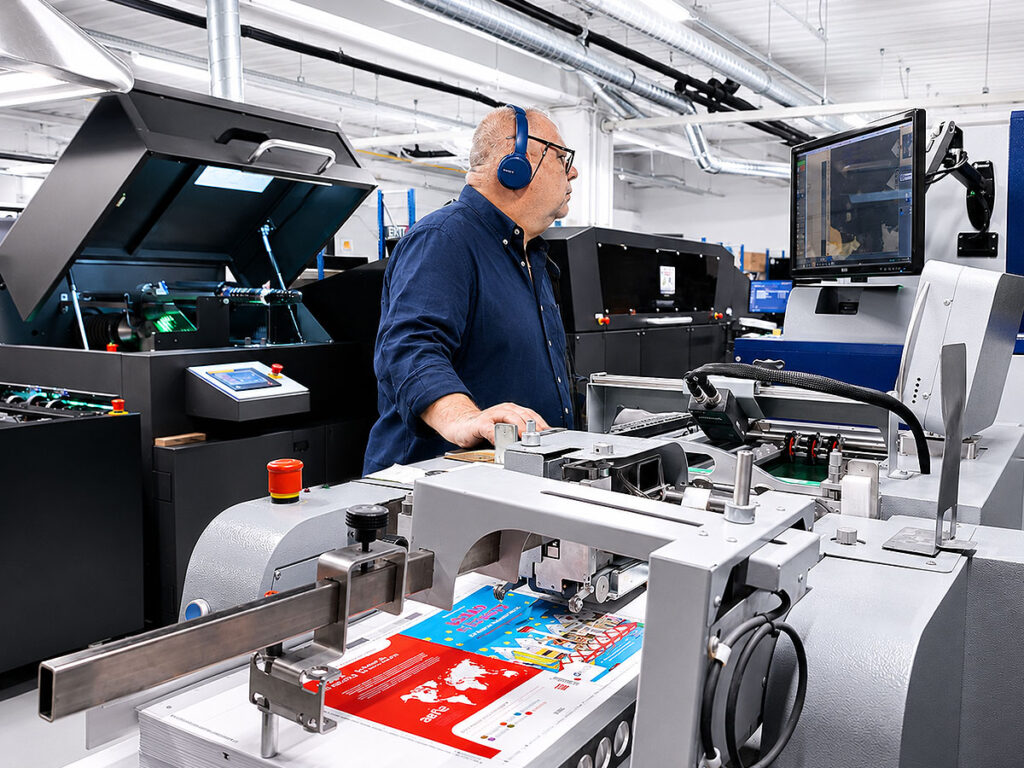
A contemporary book printing operation demands versatility from its bindery staff. A bookbinder’s responsibilities extend well beyond the purely mechanical. In an era of personalised printing and short runs, the specialist must be able to change over machines quickly and adapt production parameters to each client’s individual requirements. Key responsibilities include:
- operating and maintaining advanced in-line systems and binding machinery,
- quality control of finished products at every stage of the binding process,
- advising on the selection of appropriate binding materials, such as cover stock type and binding technology,
- troubleshooting technical issues arising from the characteristics of raw materials,
- ensuring a flawless finish – including even margins and the absence of creasing.
It is this attention to detail that determines whether a publication will be perceived as a premium product. A bookbinder must demonstrate considerable patience and manual dexterity, even when most of the work is carried out by machines. Ultimately, it is the human eye that verifies whether a spine is straight and a cover laminate is free of air bubbles.
Bookbinding Services and Types of Binding
If you are planning to publish your own book, it is worth knowing what bookbinding services are available. The choice of binding has a direct impact on how readers perceive the work and on its longevity. A professional bookbinder can advise on the optimum solution for any given project. The most common types are:
- perfect binding (softcover), the most economical and widely used option,
- hardcover (case) binding, offering maximum protection and an elegant appearance,
- integrated cover binding, a compromise between rigidity and lightness,
- saddle-stitch binding, ideal for thin publications, catalogues and manuals,
- spiral binding, frequently used for calendars and notebooks thanks to its ease of use.
Each type of book binding requires a different technical approach. Preparing a hardcover edition, for example, calls for casing-in machinery, whereas a softcover book is typically produced on a single adhesive-binding line. A bookbinder must understand the specifics of each method in order to guarantee the highest quality of execution.
Why Is the Bookbinder’s Work So Important?
It is worth emphasising that the bookbinder’s role extends beyond the purely technical sphere of production. They serve as the guardian of a publication’s durability. A well-executed binding means a book can last for generations. Incorrect paper grain direction, an insufficiently strong adhesive, or misalignment of the cover can cause a book to lose its appeal quickly – or even fall apart altogether.
The Bookbinder in a Modern Digital Print Facility
Despite the growing popularity of e-books, traditional bookbinding is enjoying a renaissance – particularly in the collector’s edition, art-book and premium segments.
If you are planning to print your book at a digital press, at Books Factory we provide comprehensive bookbinding services – from preparing the book block to precision binding. The right choice of technology and meticulous attention to every detail at the finishing stage are the guarantee of your publication’s success.