


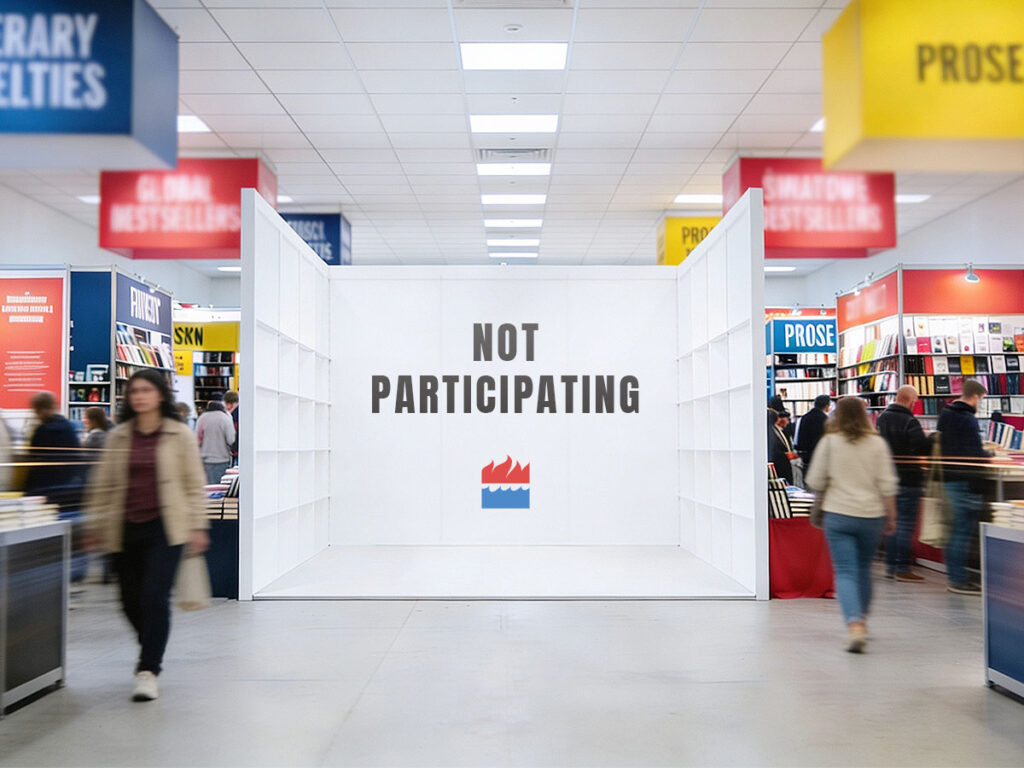
Frankfurt fair without another major publisher
For decades, the Frankfurt Book Fair has served as the central meeting point for the global publishing industry – a place where rights were negotiated, publishing programmes were presented and relationships were built between publishers, agents, booksellers and authors. Now another major player has announced that in 2026 its stand will be missing from the Messegelände in Frankfurt.
Jürgen Welte, CEO of the Hamburg branch of HarperCollins – one of the world’s largest publishing groups – has officially announced in a letter that the company will no longer be exhibiting at Frankfurter Buchmesse. This is neither a whim nor cost-cutting for its own sake. It is a deliberate business decision based on a clear diagnosis: the Frankfurt fair has stopped fulfilling the function for which publishers used to attend.
Why is HarperCollins saying “no”?
The official justification leaves little room for doubt. Welte states bluntly that “the days when the Frankfurt Book Fair was a trade fair are long gone.” In his view, the Frankfurt event has undergone a transformation: from a strictly professional trade fair towards a festival aimed at a wider public. And a fair focused on authors and readers, he notes, has for years now been filled more effectively by the Leipzig Book Fair.
Another source of frustration is the way the organisers have carried out the reorganisation of the exhibition space. The new “concept”, as Welte calls it – pointedly putting the word in quotation marks – was developed without sufficient involvement of the exhibitors themselves. “We would have preferred the reorganisation of the fair to be carried out in close cooperation with us, the publishers and booksellers, in order to develop a sustainable solution,” wrote the head of HarperCollins Germany.
This is not an isolated voice. Even at previous editions there were signals from small and medium-sized publishers that the cost of participation – stand rental, logistics, travel – is rising faster than the tangible business benefits generated by being at the fair.
Where will the savings go?
What makes the HarperCollins decision stand out from standard withdrawals from trade fairs is the clearly defined reinvestment plan. The money saved will not disappear into the corporation’s general budget, but will be channelled directly into the independent bookselling market. Specifically, HarperCollins Germany has announced:
- Regional advertising campaigns for independent, small and medium-sized bookshops – instead of a one-off trade fair presence, the publisher has decided to support the ongoing visibility of local booksellers.
- Funding for local events – author meetings, literary evenings and promotional activities organised in the bookshops themselves, rather than in anonymous exhibition halls.
- Expanding the field sales force – more sales representatives, more in-person visits, deeper, day-to-day relationships with booksellers, rather than once a year at a trade fair stand.
The HarperCollins scholarship: investing in young talent
A particularly interesting element is the launch of the HarperCollins scholarship with a total annual budget of €25,000. The programme is designed to support ten independent bookshops that offer their trainees permanent employment after completion of their training. Each of these bookshops will receive €2,500, earmarked exclusively for the professional development and skills enhancement of young staff.
In addition, an annual one-off grant of €10,000 will go to a bookseller who decides to become self-employed, either by taking over an existing bookshop or by opening a new one from scratch. There is also the opportunity to complete a two-week internship at the publishing houses Gräfe & Unzer (Munich) or HarperCollins (Hamburg), fully funded by the publishing group.
“We are investing in the competencies of tomorrow over the long term, rather than in the construction of trade fair stands for just five days. We look forward to meeting you not in an anonymous exhibition hall, but directly at your premises, in your bookshops, at shared evenings and events,” Welte summed up. This statement neatly captures the philosophy behind the entire decision.
Book fairs in an identity crisis
The decision by HarperCollins Germany was not made in a vacuum. It is part of a broader trend that has been visible on the European publishing market for several years. There is growing uncertainty about what major book fairs are actually supposed to be in the third decade of the 21st century.
Caught between trade fair and festival
For years, Frankfurter Buchmesse has tried to balance two roles: a professional B2B trade fair (rights trading, licensing negotiations, meetings with distributors) and an open cultural event for readers. The problem is that it is becoming increasingly difficult to reconcile these two functions within a single space and format.
Publishers come to Frankfurt looking for specific business outcomes: deals, contacts, orders. At the same time, a growing part of the programme and infrastructure of the fair is being designed with the mass public in mind: panel discussions, author events, selfie zones and lifestyle activities. For a major publisher paying tens of thousands of euros for a stand, this is an increasingly unappealing model.
Leipzig vs Frankfurt: a shifting balance of power?
There is a reason why Welte pointed to the Leipzig Book Fair as a point of reference. Leipziger Buchmesse has, for years, consistently built its position as a fair closer to readers and authors, with a strong literary and educational component. If Frankfurt is losing trade exhibitors and Leipzig is attracting the public, the question of whether it still makes sense to maintain two major events in their current formats becomes increasingly pressing.
This does not mean that the Frankfurt fair will disappear. It remains the world’s largest publishing event in terms of the scale of rights trading. But its role as the place “to be” is clearly weakening – at least for some exhibitors.
What does this mean for the publishing market?
The move by HarperCollins Germany can be interpreted on several levels. Most obviously, it signals that large publishers are willing to challenge long-standing industry rituals if they no longer deliver tangible results. On a deeper level, it reflects a shift in thinking about where and how relationships with the market are built.
Independent bookshops as the foundation
The slogan “books need bookshops”, with which HarperCollins framed its decision, may sound like a catchphrase, but there is a real calculation behind it. In Europe, independent bookshops – despite pressure from e-commerce platforms and discount chains – still account for a significant share of book sales, particularly in the literary fiction and non-fiction segments. They are where readers receive recommendations and where local communities are built around books.
A publisher that invests in booksellers’ skills, in their visibility and in their survival is, in effect, investing in its own distribution channel, only in a more sustainable way than a five-day trade fair stand.
Alternative promotion models
The HarperCollins decision is part of a broader trend in which publishers are seeking alternative models for book promotion. Increasingly, publishers are experimenting with:
- Local and regional events – smaller but more frequent promotional campaigns in bookshops, libraries and cultural venues.
- Direct support for booksellers – training programmes, merchandising materials and dedicated marketing budgets for points of sale.
- Digital formats – webinars, virtual author events and online platforms for ordering rights and licences, which are partly taking over the B2B role traditionally played by fairs.
- Partnerships with printers and logistics providers – shortening the supply chain, print-on-demand and flexible print-run models, which allow publishers to respond faster to demand without needing a massive showcase at a trade fair.
Books Factory’s perspective – what we see from the printer’s side
From the perspective of a digital printer working daily with publishers, self-publishing authors and bookshops across Europe, the decision by HarperCollins Germany confirms a trend we have been observing for some time: the publishing market is moving away from the model of “big events” towards a model of continuous, decentralised collaboration.
For publishers, this means greater flexibility: they can test smaller print-runs, print closer to the target market and respond to real demand rather than forecast it six months ahead of a fair. For independent bookshops, it is an opportunity for deeper partnerships with publishers that go beyond the standard supplier–customer relationship.
And for the entire industry? Perhaps it is time for an honest conversation about whether the traditional model of major book fairs still serves those who finance it, or whether it survives largely out of habit.
Conclusion – courage to change or the beginning of the end for book fairs?
Jürgen Welte ended his letter with the words: “Change requires courage, but it creates space for genuine innovation and shapes our future.” It is hard to disagree with this, regardless of how one evaluates the decision itself.
HarperCollins Germany is not withdrawing from the market; rather, it is shifting its presence from exhibition halls to the places where books actually reach readers – bookshops. Instead of five days a year, it is opting for 365. Instead of one large stand, it is choosing dozens of small partnerships.
Will other major publishers follow the same path? Some likely will, especially those that have long questioned the rising cost of fair participation in the face of declining returns. Frankfurter Buchmesse now faces a challenge: either it finds a new formula that will convince exhibitors to return, or it must reconcile itself to the role of a primarily cultural – rather than business – event.
One thing is certain: the publishing market is not standing still. Those who are able to adapt their business models to a changing reality will gain an advantage – regardless of whether they have a stand in Frankfurt or not.
Sources: