


The market is growing… just not where it used to
The figures from NielsenIQ BookData and GfK Entertainment, presented at the London Book Fair 2026, resist any simple conclusion. The book market in 2025 did not grow evenly.
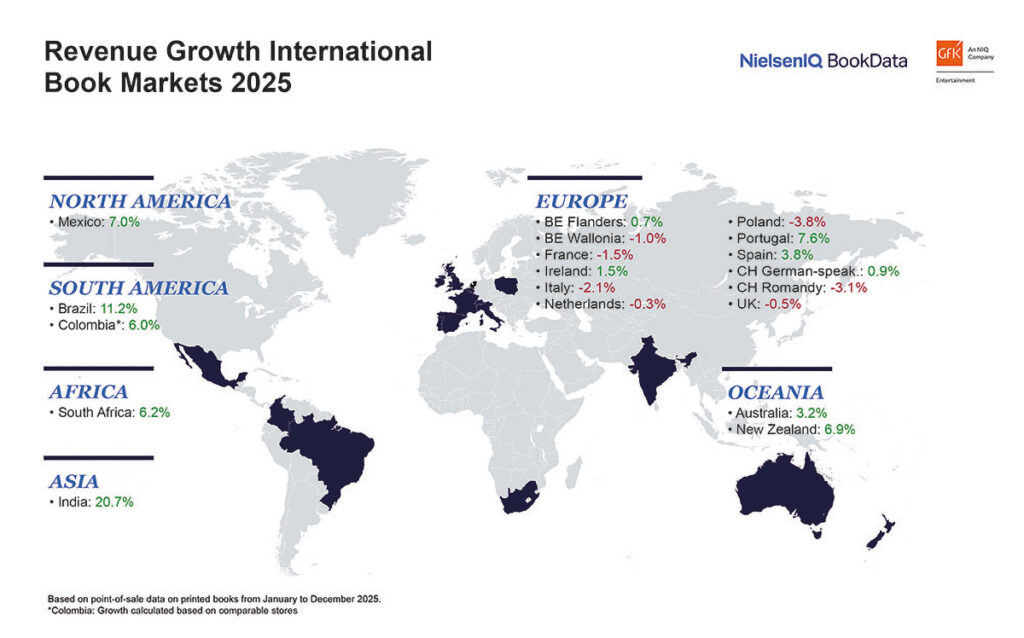
The strongest momentum is now clearly outside traditional publishing hubs. India (+20.7%), Brazil (+11.2%), and Mexico (+7.0%) are leading growth, while Oceania has rebounded strongly, with Australia (+3.2%) and New Zealand (+6.9%) returning to positive territory.
By contrast, major European markets are slowing. Italy (-2.1%), France (-1.5%), and the United Kingdom (-0.5%) all recorded declines. This is no longer a market in expansion mode, but one in selection: more mature, more demanding, less impulsive.
Fewer books, more value
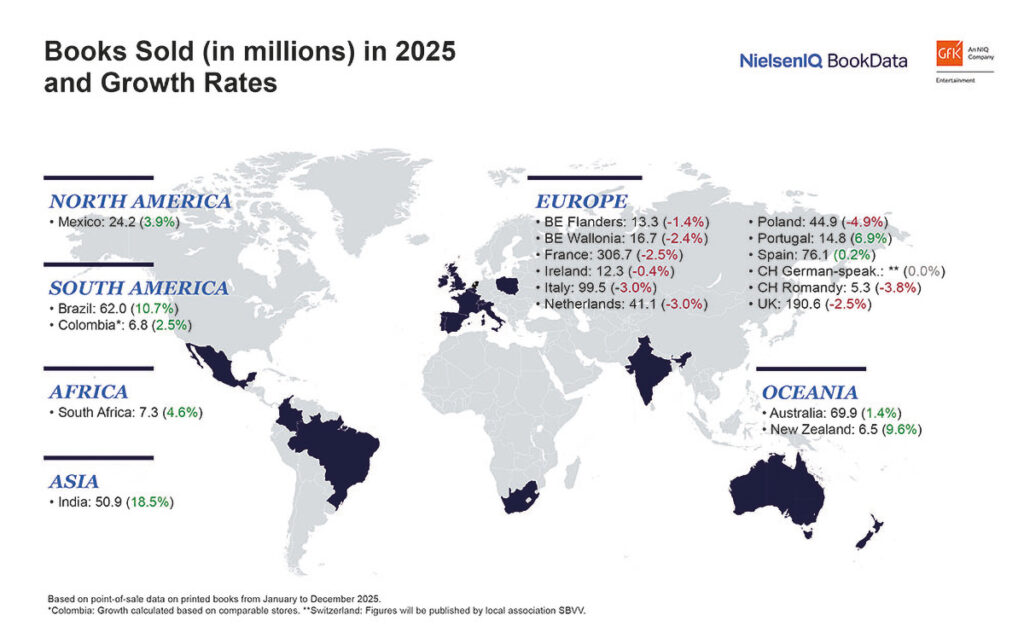
An even more revealing picture emerges when we look beyond revenue and focus on unit sales. In many markets, the number of copies sold is declining, while revenues remain stable or continue to grow. This tension is key.
It’s not that readers are turning away from books. What’s changing is how they buy. Purchasing decisions are becoming less spontaneous and more deliberate. A book increasingly has to “earn” its place in the basket.
This marks a shift in market logic: fewer random choices, more intentional decisions.
Fiction takes the lead
In this context, it’s no surprise that fiction remains the market’s strongest segment. In 2025, it drove revenue growth in 15 of the analysed territories.
But it’s not just about genres — although crime, thrillers, and fantasy clearly dominate. What matters more is the mechanism behind their success. Books now circulate within culture differently than they did just a few years ago. Authors like Freida McFadden — whose “The Housemaid” topped charts in multiple markets — or Dan Brown, whose “The Secret of Secrets” ranked among the top three titles in several countries, illustrate this shift. Just as important is how books are discovered.
Today, social media plays a decisive role — especially visual-first platforms like TikTok and Instagram. A book is no longer just content. It becomes an object to showcase, photograph, and “unbox”. Subtle — but fundamental.
Non-fiction isn’t disappearing — it’s changing its role
Compared to fiction, non-fiction is under more pressure, with only seven markets recording revenue growth in 2025.
The strongest performers are books that offer clear, practical value: helping readers understand the world, make decisions, or organise everyday life. Titles such as “The Let Them Theory”, along with enduring bestsellers like “Atomic Habits”, “Ikigai”, and “The Psychology of Money”, confirm that demand for self-development remains strong.
What’s changing is the intent. Non-fiction needs to be more precise, more actionable, and more closely connected to the reader’s present reality.
Prices are rising — but the market is slowing
Another piece of the puzzle is pricing. In most markets, prices continued to rise in 2025, although less sharply than in the previous year.
The UK saw average prices increase by 2.0% to £9.52, while France recorded a 1.0% rise to €12.83. At the same time, several markets showed a clear slowdown in price growth, suggesting a new balance between price acceptance and expectations around quality.
Readers have accepted higher prices — but not unconditionally. Price increases need to be justified through production quality, aesthetics, and the overall experience. This is the moment when the physical form of a book starts to matter more than ever.
What does this mean for publishers?
The most important shift is not about specific markets or genres. It’s about how we think of the book as a product.
Just a few years ago, strategy could be built on scale: larger print runs, lower unit costs, broad distribution. Today, that model is increasingly under pressure. In its place, a more careful and intentional approach is emerging:
- shorter print runs,
- market testing,
- greater focus on production quality,
- stronger alignment with a clearly defined audience.
This isn’t a revolution. It’s an evolution — one that reshapes everyday publishing decisions.
Towards the book as an experience
If we were to sum up 2025 in a single sentence:
- the physical book is no longer just a content carrier — it is becoming an experience.
This is reflected in rising prices, the popularity of collector’s editions, and the growing importance of detail. But also in how books function in digital spaces — as objects that capture attention even before the first page is read.
For publishers, this leads to one clear conclusion: production decisions are no longer purely technical. They are strategic. And they should be made consciously, because they determine how a book will be perceived. Ideally not just on screen, but in direct contact with the physical product — where the project reveals how it truly performs in reality.
Sources: