


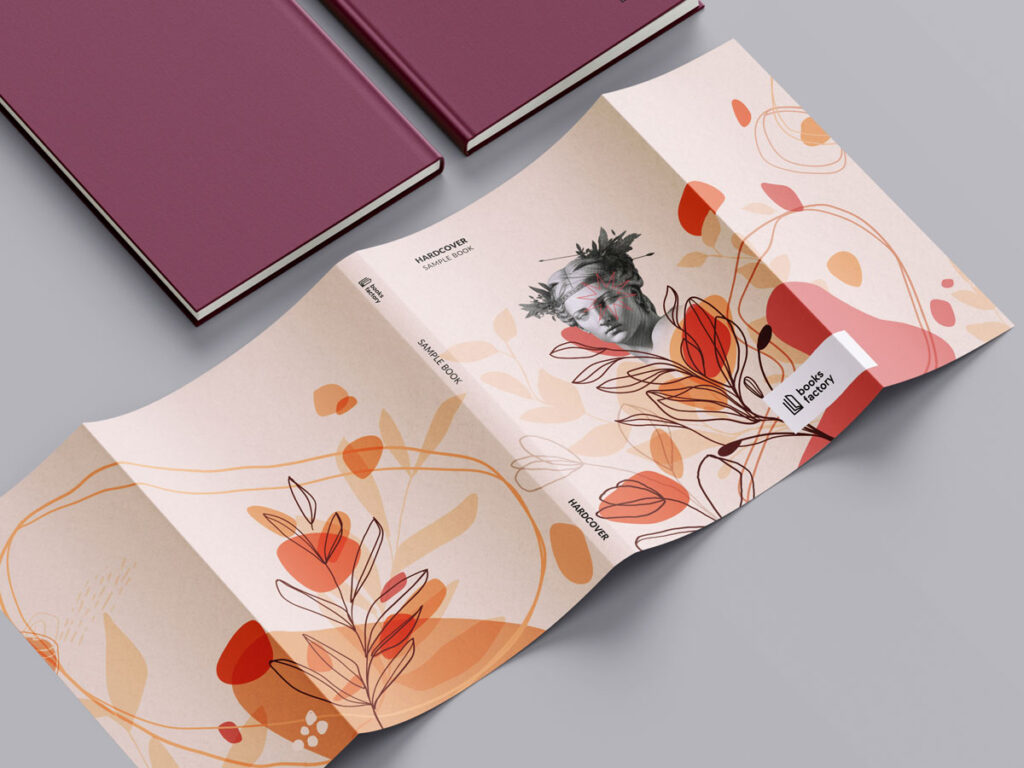
A dust jacket is an addition that gives a publication a completely new character – both in terms of aesthetics and functionality. It is an information carrier that serves both an organizational and marketing purpose. What is a dust jacket, what are its types, and what are the practical aspects of its use?
What is a dust jacket exactly and where can it be used?
A book dust jacket is a paper wrap (a removable extra cover) that protects and decorates the actual cover of the publication. You can see it, for example, in bookshops or libraries. However, it is worth remembering that its role is not limited to merely securing the books themselves.
Medium-weight paper is most commonly used for its production. At Books Factory, we use 200 g/m² double-sided coated glossy paper for this purpose. Using paper with a lower grammage would reduce the durability of the dust jacket, whereas stiffer cardboard would make it difficult to fit aesthetically to the book spine.
The role of the dust jacket in the publishing industry
Dust jackets used in the publishing industry differ significantly from those found, for example, in general retail packaging. Yes, in both cases we are talking about a solution that works as an additional form of advertising and an information carrier, but it is worth remembering that the dust jacket performs another vital function: it effectively protects the book. It secures the cover (whether printed or made of fine veneer) against scratches and dirt.
Thanks to dust jackets, books gain a completely new, prestigious look that catches the eye and encourages purchase. This is influenced by many elements, such as gilding and spot varnish, which relate to the cover design. The advantage of dust jackets is also the method and quality of their execution. High-quality coated paper is most often used for their production, which aesthetically encourages engagement with the publication’s content and relates to the cover design.
The dust jacket also serves as an effective informational tool. Standardly, the title and the author’s name are printed on it. Reviews and a photo of the writer often appear on it as well. The graphic design, which may relate to the content of the book or refer to it symbolically, also plays a key role. Thanks to this, both elements of the publication interact with each other, creating a coherent thematic and graphic message.
Belly band or dust jacket – how do they differ?
In the publishing industry, we encounter two main elements protecting and decorating the cover: the dust jacket and the belly band. The difference between them is that a belly band is a strip of paper that wraps around the publication. It performs an informational and marketing function, but does not protect the entire surface of the cover from damage. An interesting example of information that often appears on a belly band is a mention of the author receiving, for example, a Nobel Prize.
In turn, the dust jacket aims to protect the entire surface of the cover. Unlike the belly band, it is not just a simple element surrounding the book, but a loose wrap covering the cover, equipped with flaps that are folded into the interior of the book. It is worth adding that the minimum width of the dust jacket flaps should be no less than 55 mm and no more than 250 mm – at Books Factory, we recommend 2/3 of the book format.
Can a dust jacket be personalized?
A dust jacket is not just additional protection for a book. It is a space that can be freely personalized. Thanks to this, the author and publisher can give the publication an individual character, allowing it to stand out from other books. The content presented by the dust jacket can be tailored to the recipient, a marketing campaign, and a specific occasion.
Target group analysis – what should a dust jacket contain?
A dust jacket is a space that is personalized taking into account:
- the age and statistical profile of the reader to whom the publication is addressed,
- the context of the book purchase,
- preferred visual motifs.
The content of dust jackets is perfectly visible in the example of youth books, distinguished by dynamic graphics tailored to the recipient’s profile. This principle also applies to collector’s editions, usually dominated by minimalist typography.
Trends in dust jacket design
Current trends also influence the final appearance of dust jackets. Currently, eco-friendly solutions created from environmentally friendly materials are very popular. Premium dust jackets with high functionality are also enjoying growing interest. They contain, among other things, QR codes that allow access to additional multimedia content related to the publication.
Fans of selected titles also influence the shape and form of dust jackets; in cooperation with authors (e.g., within a specific community), they can contribute their suggestions and corrections. This trend is especially visible in self-publishing.
Dust jacket personalization techniques
Thanks to appropriate personalization techniques, virtually any effect can be created. Digital printing allows, for example, for the customization of short series of publications. In turn, jacket with matt soft touch laminate gives the surface a velvety softness, making it extremely pleasant to the touch. Clients also eagerly choose hot-stamping, i.e., embossing with metallized foil. This method improves the visibility of logos, titles, and other inscriptions.
In summary, the dust jacket combines marketing and informational functions, simultaneously offering great possibilities for personalizing the publication with a specific group of recipients in mind.
Do you want to be sure that your dust jacket will fit the book perfectly? Use our template generator and download a precise mock-up ready for design.