


Launching a new title on the market is always a logistical challenge. Whether you represent a publishing house planning a new series, or you are an author realising your first project, the moment you hand over the files for printing is crucial. How to avoid mistakes? What does the production process look like from behind the scenes?
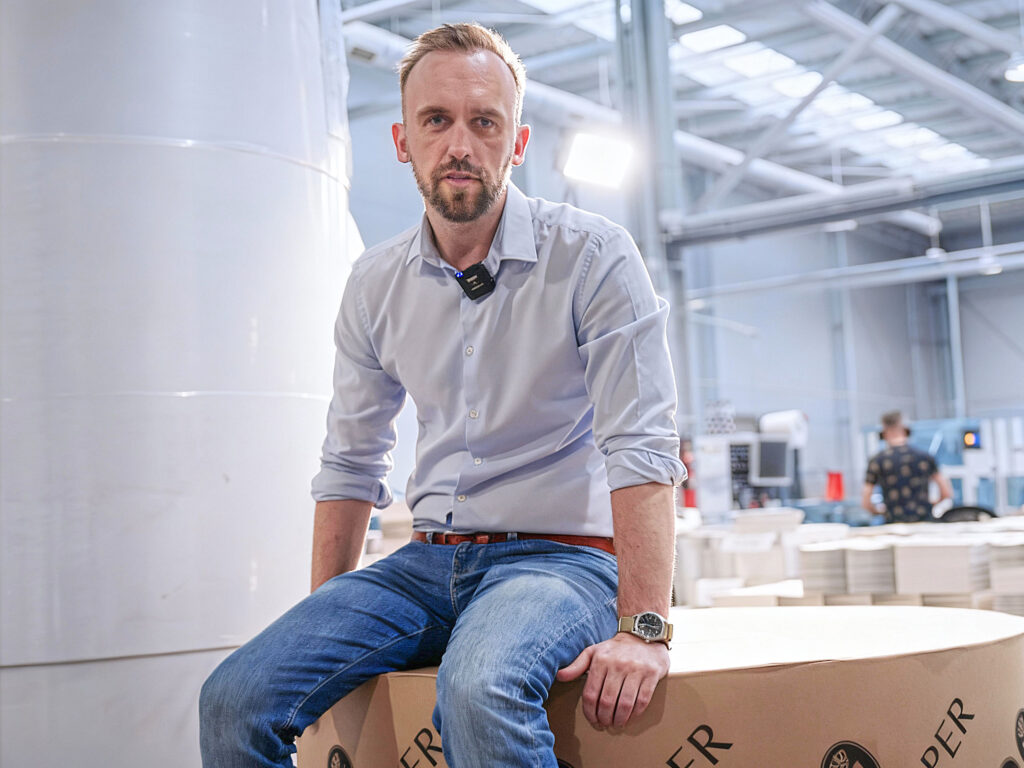
Łukasz Moleski, Sales Director for the Polish market at Books Factory, knows these dilemmas inside out. He has been working with us “from the early days” – he remembers when the team consisted of just 16 people, and he helped grow it to the current 300 employees. In our vlog, he guides clients through the intricacies of the printing process.
Step 1: Registration and support from a dedicated manager
Many online printing houses focus on full automation, where the client is just an order number. At Books Factory, the process starts in a standard way – by registering on the website and providing company details. However, a key difference appears at this very stage.
When creating an account, you choose your dedicated sales representative from a list. Why is this so important? Although you can use the price calculator on the website, Łukasz advises consulting your account manager for your first order.
We are here in the sales department to help you, so don’t be afraid to call. This way, we will certainly avoid many mistakes – he emphasises.
The sales representative will help clarify the specifications: from the type of binding (hardcover, softcover, saddle-stitched, spiral), through paper selection, to cover finishes.
Step 2: Quality verification – Sample Books and Proofs
The biggest fear with digital printing is uncertainty about the final result. To dispel this, Books Factory offers tools that allow you to “feel” the product before commissioning the entire print run:
- Sample Book package: after registration, we send a set of samples. This allows you to physically assess the paper quality and choose the appropriate finishes.
- Proof copy: an absolute game-changer for new clients. With your first order, you have the opportunity to receive a free test print – and importantly, this applies to your first three titles. Thanks to this, you see the final product before the main machinery starts running.
Step 3: Files and DTP control
You already have the quote and certainty about the materials. It is time to send the files – via FTP, e-mail, or WeTransfer.
Once the files reach the printing house, the DTP department takes over. They check the technical correctness of your project:
- Is the format correct?
- Are the bleeds preserved?
- Does the book spine have the appropriate width?
Important note: the lead time only begins from the moment the files are accepted as technically correct. It is worth remembering this when planning the premiere date.
Step 4: Time and logistics
How long will printing take? It depends on the publishing calendar. Seasonality in the printing industry is a fact – different deadlines apply in autumn (pre-Christmas peak) than in summer. You can always check current lead times on our website.
When the print run is ready, packing follows. Here, logistics depend on the size of the order:
- Orders weighing less than 100 kg are sent in secure cardboard boxes.
- Larger print runs, exceeding 100 kg, are transported on pallets for safety.
The printing process is a team game. From your project, through sales support, to DTP control and final delivery. As seen in the example of Łukasz, who personally delivers an urgent order in the vlog – at Books Factory, technology serves people, and sales support is the standard.