


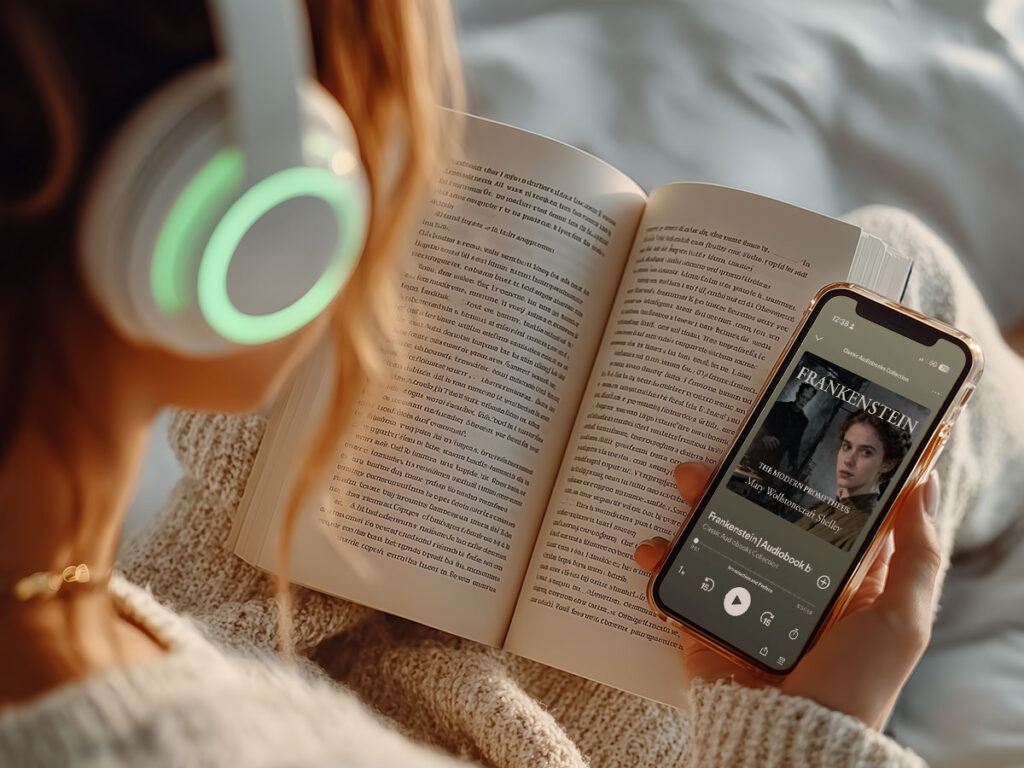
Spotify steps into the world of books
For several years now, Spotify has been expanding its audiobook segment. Page Match, however, is its first clear move towards connecting the worlds of print and audio. It is no longer just about making an audio file available. It is about synchronising the experience of reading and listening.
This is not a technological revolution. It is rather an attempt to remove a small but real friction point: the moment when a reader puts a book down, leaves the house, and has to manually search for the right passage in the audiobook.
What is Page Match?
Page Match allows users to:
- scan a printed book page and jump directly to the corresponding moment in the audiobook (“Scan to listen”),
- after listening, photograph any part of the text and find the correct page in the printed book (“Scan to read”). Spotify then indicates where to resume reading.
The application uses image recognition (OCR) and content matching. It does not rely on page numbers but on sentence analysis. As a result, the feature works independently of edition or format.
Spotify emphasises that photos are not stored. They are used solely to recognise text and match it with the recording. This point is central in the context of privacy and copyright discussions.
At present, Page Match is available in markets where Spotify offers its full audiobook catalogue — mainly English-speaking countries.
Not the first synchronisation model
Page Match is often compared to Amazon’s Whispersync, which synchronises a Kindle e-reader with Audible audiobooks. The difference lies in the ecosystem: Amazon operates within a closed environment — the reader, the store and the audio platform belong to the same company.
Similar solutions also exist in Poland. Legimi has long offered so-called “synchrobooks”, allowing users to switch seamlessly between e-book and audiobook within the platform.
Spotify’s novelty lies elsewhere: the feature works with a printed book, without requiring a dedicated e-reader or a specific e-book file. A physical copy and the app are enough.
Moreover, Spotify has announced a partnership with Bookshop.org in the United States and the United Kingdom, enabling users to purchase the printed edition directly from within the app.
What does this mean for publishers and authors?
1. A new point of contact with the reader
Spotify has a vast Premium user base, many of whom do not necessarily use dedicated audiobook platforms. Page Match may:
- increase audiobook exposure among users already within the Spotify ecosystem,
- facilitate content consumption in a “read at home – listen on the move” model,
- extend the time spent with a single story.
For publishers, this represents an additional distribution channel that can expand catalogue reach — particularly in markets where audiobooks are growing faster than e-book sales.
2. Questions about the remuneration model
In the music industry, Spotify has built scale while simultaneously triggering discussions about creator remuneration. Similar questions are emerging in audiobooks:
- Is compensation based on listening time?
- How is data reported?
- Are long-form works rewarded, or fragmented?
For publishers and authors, entering a platform is only part of the equation. Licensing terms and reporting transparency remain decisive.
3. The importance of textual consistency
Page Match relies on sentence matching. This means the printed and audio versions must be fully aligned. Editorial changes between editions, abridged recordings or translation differences may affect the feature’s performance.
This strengthens the argument for structured version control in the publishing process.
And what about printers?
At first glance, Page Match appears to concern the digital sphere only. In practice, it presupposes the existence of a physical book — the user must hold it in order to scan a page.
This sends an interesting signal to the print market:
- the printed book does not disappear from the digital ecosystem,
- it becomes a reference point for the audio experience,
- it can co-create a multi-format consumption model.
In this context, print quality, durability and edition aesthetics gain importance. If the printed version is to function alongside the audiobook, its quality, textual consistency and repeatability become elements of the overall publishing strategy.
Opportunity or risk?
Page Match does not redefine market fundamentals. It reinforces the multi-format trend. The same story exists simultaneously as print, e-book and audiobook — and the user moves freely between them.
For publishers, this implies the need to:
- plan parallel editions (print + audio),
- analyse licensing agreements with platforms,
- manage catalogues strategically.
For self-publishers, it may represent a new way to reach audiences who already spend many hours each month within a single application.
Where is the market heading?
Page Match shows that the boundaries between formats are increasingly blurred. The question is no longer “print or audio”. It is about designing a reading experience that accompanies the audience throughout different moments of the day.
For the printing industry, this is not an alarm signal. It is rather confirmation that the physical book remains a vital element of the ecosystem — even in a world dominated by applications.
Technology may change how content is consumed. But it still begins with text — and with a well-prepared edition.
Sources:
- Spotify Authors – Introducing Page Match, a New Way to Stay Immersed in the Books You Love
- Spotify Newsroom – How to Use Page Match to Seamlessly Switch Between a Book and an Audiobook
- USA Today – article about a feature release