


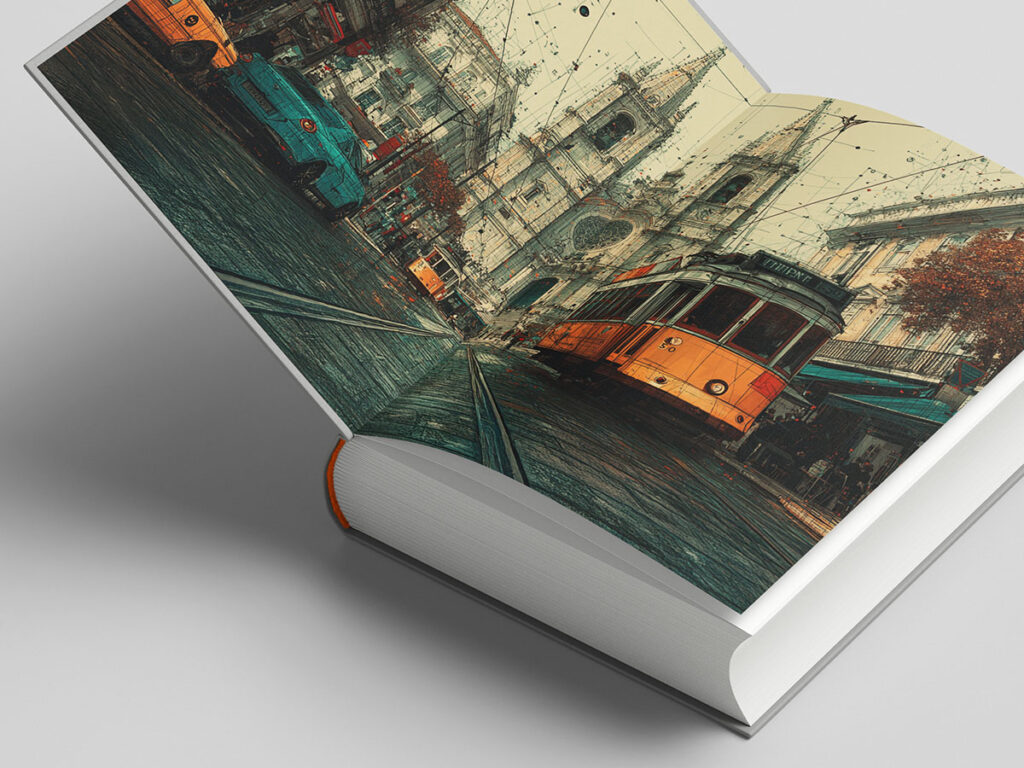
Endpapers, referred to in bookbinding terminology as endsheets, are one of the key structural elements of a hardback book. Endpapers for books serve both a technical and an aesthetic function, influencing the durability and perception of a publication. In this article, we explain in detail their construction, purpose and the available variants used in book production.
What Are Endpapers – Definition and Function
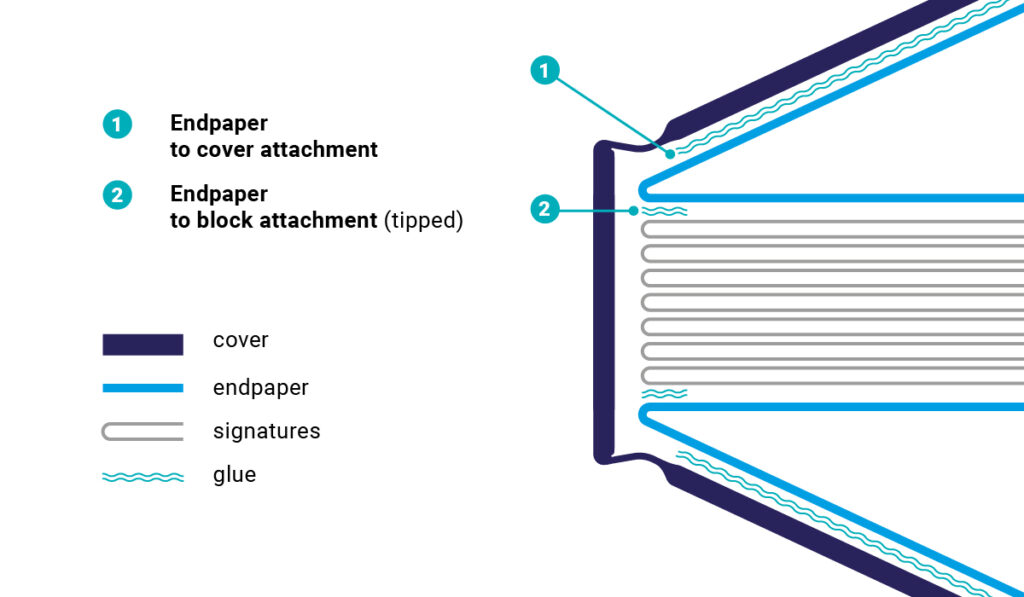
What are endpapers in the publishing industry? An endpaper is a double-leaf structural element of a hardback book that connects the book block with the cover and conceals the inside of the cover board. One leaf is permanently attached to the first and last section of the book block, while the other is glued to the inside of the cover.
Its primary role is to reinforce the book’s construction by stably transferring the stresses generated during opening and closing. Endpapers should be made of paper with appropriate strength and grammage (often higher than the book block paper), and the grain direction should run parallel to the spine. Proper endpaper construction also conceals binding joints – such as sewing or gluing – improving both aesthetics and durability.
What Are Endpapers Used For?
Endpapers in bookbinding play a very important role. Their main functions include:
- stable connection between the book block and the cover, absorbing the stresses generated when the book is opened and closed,
- protection of the first and last pages of the book block from mechanical damage and dirt resulting from regular use.
During everyday use, endpapers are exposed to repeated physical stress caused by continuous opening and closing. For this reason, the paper used must provide appropriate strength and stiffness.
Types of Endpapers and Endpaper Papers – Discover the Books Factory Offer
In bookbinding practice, endpapers may differ in construction (for example, they can be reinforced or multi-part).
At Books Factory, we most often produce endpapers attached to the book block (tipped), which may differ in paper type, grammage and printing options. Below is a detailed overview of the available materials.
- Default paper, matched to the interior colour. As the name suggests, it is matched to the book block. This typically refers to Uncoated or coated paper with a grammage usually ranging from 120 to 150 gsm. The advantage of this solution is consistency with the book interior and cost efficiency.
- Uncoated paper. A solid and fairly standard solution with a grammage of 150 gsm. Uncoated paper is particularly suitable for endpapers intended for printing.
- Munken Print Cream v1.5 is selected, among other reasons, for its natural character and uncoated surface. It is easy to print on and features a subtle creamy shade that gives the publication a warm, refined and premium look.
- Munken Print White v1.5 – a stock with a grammage comparable to Uncoated paper or Munken Print Cream. This solution combines high production quality with an uncoated surface and a white shade. It ensures excellent colour reproduction, resulting in higher print quality.
- Mass-dyed paper. An option for those seeking solutions that offer elegant contrast with the rest of the publication. The colour runs throughout the entire sheet thickness, ensuring an aesthetic and uniform appearance. In the Books Factory offer, Mass-dyed paper is available in 7 variants (non-printable):
- black,
- red,
- brown,
- dark blue,
- ecru,
- green,
- yellow.
The colour of the Mass-dyed paper can be selected in our hardback calculator.
Endpaper Printing at Books Factory – Everything You Need to Know
At Books Factory, we offer various endpaper printing options. The numbers 1 and 4 used in the notation correspond to black-and-white printing (1) and colour printing (4).
According to this scheme, we offer:
- single-sided black and white (1+0),
- single-sided colour (4+0),
- double-sided black and white (1+1),
- double-sided colour (4+4),
- no printing (0+0).
Please note that endpaper printing is not available on Mass-dyed paper.
Endpapers and Their Role in Publication Design – Design Guidelines
How to Use Endpapers in the Design Process?
Endpapers are an important element of a publication, influencing the final design and durability of the book, while also supporting its informational message. A key feature of endpapers is the large graphic area, which can be used to strengthen branding, define the atmosphere of the publication and emphasise the book’s theme.
Various graphic elements can be placed on the surface, including solid patterns (also referred to as patterns), illustrations, as well as family trees and maps related to the book’s content.
Endpapers and Design Recommendations
Before selecting a specific variant, ensure that the colour (shade) harmonises with the cover and spine. An example of an interesting visual effect is the contrast between white Munken paper and a dark cover.
When preparing the design, both trim size and appropriate bleed and safe margins must be taken into account. Endpapers are a two-page element (left and right leaf), prepared as a spread, which in practice means defining bleed on the outer edges and a safe margin along the glue line.
Designers should remember that one leaf of the endpaper is fully glued to the inside of the cover and remains invisible after binding. This means not all areas should contain graphic elements – our template generator indicates which zones do not require artwork.
How Can Endpaper Templates Be Generated Quickly?
Although preparing an endpaper template may initially seem complex, in practice the process becomes much simpler thanks to dedicated digital tools.
At Books Factory, we have prepared an Endpaper Template Generator that allows you to:
- speed up design work,
- reduce the risk of technical errors at the file preparation stage,
- download a template with correct dimensions and technical zones for further work.
Those who wish to download a template and check its technical specification can use the Endpaper Template Generator free of charge.
From the generator, you can create a technical template that serves as the basis for graphic design. In the print calculator, you select the paper, printing option and place your order.
The template generator is a good first step. If you are wondering what endpapers are and which types will work best in your publication, use our generator and hardback calculator.
Sources:
- Sławomir Magdzik, Introligatorstwo przemysłowe, WSiP, Warszawa 1988.